

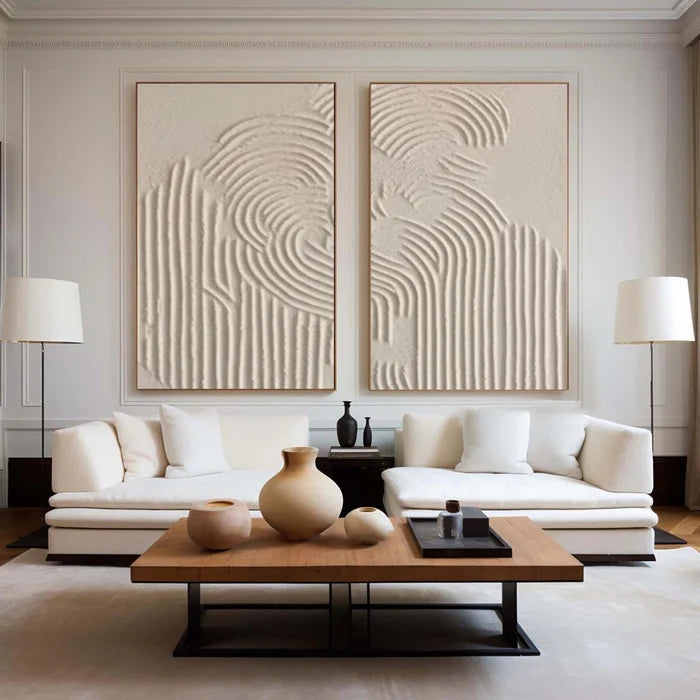

Luxury wall art that feels made for your space rather than chosen from a catalogue
Luxury wall art is often treated as a label—something expensive, branded, or tied to a recognizable name. In practice, what makes a piece feel genuinely luxurious in a home is far more specific: scale that fits the wall precisely, texture that responds to light, and a palette that quietly organizes everything around it. The shift happening in high-end interiors is subtle but important. Designers are moving away from mass-produced statements and toward original, hand-painted work that behaves like part of the architecture. That difference—between something you hang and something that belongs—is where luxury starts to feel real.
Why designers are moving beyond recognizable brands
There is a growing hesitation among interior designers to rely on widely circulated artwork, even when it carries prestige. The issue is not quality alone; it is repetition. When a piece appears across multiple homes, it stops anchoring the space and starts signaling familiarity.
Instead, designers are prioritizing originality and material presence. A hand-painted canvas with visible brushwork or plaster texture carries small irregularities that cannot be replicated at scale. These irregularities are not flaws—they are what allow the artwork to interact with natural light, shifting slightly throughout the day. That quiet movement gives a room depth that printed or mass-produced works rarely achieve.
In this context, luxury becomes less about recognition and more about relevance. The artwork earns its place by fitting the room, not by standing apart from it.
The role of scale in defining a room’s atmosphere
A common mistake in high-end interiors is treating artwork as a finishing touch rather than a structural element. In reality, the right scale of luxury wall art can determine how balanced or disjointed a room feels.
Designers typically begin with proportions. A large painting above a sofa should span roughly two-thirds to three-quarters of the furniture width. In dining rooms or entryways, oversized vertical pieces can elongate walls and subtly guide movement through the space.
What matters most is not simply going “big,” but choosing dimensions that align with architectural lines—ceiling height, wall width, and furniture placement. Custom-sized artwork often becomes the solution because standard formats rarely align perfectly with real interiors.
This is where collections like the Designer-Curated Collection become relevant: not as a catalogue to browse passively, but as a starting point for understanding how scale and composition can be tailored to specific rooms.
Material presence changes how art is experienced
The difference between luxury wall art and decorative wall pieces often comes down to material weight and surface.
Paint applied with body—whether acrylic or plaster—creates a raised surface that interacts with shadow. On heavier linen or canvas, this texture feels grounded rather than superficial. The artwork becomes tactile even when untouched.
By contrast, flat prints or thin canvases tend to sit on the wall rather than integrate with it. Under directional lighting, they reveal their limitations quickly—no depth, no variation, no visual response.
Designers often use textured paintings strategically:
-
In minimalist spaces, texture replaces color as the primary visual interest.
-
In neutral interiors, it prevents the room from feeling flat or overly controlled.
-
In large open-plan layouts, it helps define zones without adding clutter.
The material itself becomes part of the design language, not just a carrier for an image.
Color anchoring instead of color matching
One of the more refined approaches to luxury wall art is using it to anchor a palette rather than match it.
Matching—trying to replicate exact tones from cushions or rugs—often results in a room that feels overly coordinated. Anchoring works differently. The artwork introduces a palette that other elements respond to more loosely.
For example, a painting with layered neutrals and subtle warm undertones can unify wood finishes, upholstery, and flooring without repeating any single color exactly. This creates cohesion without rigidity.
Designers frequently select artwork early in the process for this reason. It becomes a reference point for paint samples, textiles, and finishes, rather than a final addition trying to tie everything together.
When handcrafted art solves layout challenges
Not every wall is standard, and this is where off-the-shelf artwork begins to fall short. Long hallway walls, double-height living rooms, or narrow vertical spaces often require unconventional dimensions.
Custom or made-to-fit paintings allow for:
-
Horizontal formats that stretch across wide walls without fragmentation.
-
Vertical compositions that emphasize height in compact areas.
-
Multi-panel arrangements that adapt to architectural features.
A common scenario in modern homes is the oversized sofa paired with undersized art. The result is a visual imbalance where the furniture dominates and the wall feels unresolved. A properly scaled, handcrafted piece corrects this immediately—not by adding more objects, but by restoring proportion.
This is less about decoration and more about spatial correction.
Where handcrafted luxury wall art fits and where it does not
Hand-painted, textured artwork excels in spaces that benefit from calm authority—living rooms, bedrooms, dining areas, and professional offices where atmosphere matters.
However, it is not always the right solution. Highly graphic or fast-changing environments, such as children’s playrooms or trend-driven commercial spaces, may benefit more from flexible, replaceable decor.
There is also a consideration of expectation. Textured paintings will not look identical from every angle or under every light condition. Buyers expecting perfect uniformity may find that surprising. Understanding this variability is part of appreciating handcrafted work.
A quieter way to approach buying art online
For many buyers, hesitation around luxury wall art is not about taste—it is about uncertainty. How will it look on the wall? Will the size feel right? Does the texture translate from images?
This is where supportive tools and advisory become useful rather than promotional. An online shop for original paintings such as Vinchy Art addresses this by offering practical ways to reduce guesswork. A room preview tool allows you to upload your wall and test scale visually, while an art advisory service helps align palette, size, and orientation with your existing interior elements.
For those considering something more tailored, you can explore options or discuss your space through their Bespoke Art Services, which focus on adapting artwork to the room rather than forcing the room to accommodate the artwork.
Frequently Asked Questions
What makes wall art “luxury” rather than just expensive?
Luxury wall art is defined by how well it fits a space, the originality of the work, and the quality of materials. Hand-painted pieces with texture, thoughtful scale, and a palette that anchors the room tend to feel more luxurious than mass-produced items, regardless of brand name.
Is large wall art always better for high-end interiors?
Not always, but scale is critical. Larger pieces often work better because they create visual stability and reduce clutter. The key is proportion—art should relate to furniture and architecture rather than simply filling space.
How do I choose colors without making the room look too coordinated?
Focus on anchoring rather than matching. Select artwork with a palette that complements the room’s tones without duplicating them exactly. This creates a more natural and layered look.
Are textured paintings harder to style than flat prints?
They require slightly more consideration because they interact with light and shadow. However, this also makes them more versatile in neutral or minimalist spaces, where texture can replace bold color.
Can I confidently buy luxury wall art online without seeing it in person?
Yes, but it requires careful evaluation. Check dimensions closely, understand the material (especially texture), and use tools like room previews when available. Advisory services can also help bridge the gap between digital images and real-world placement.