

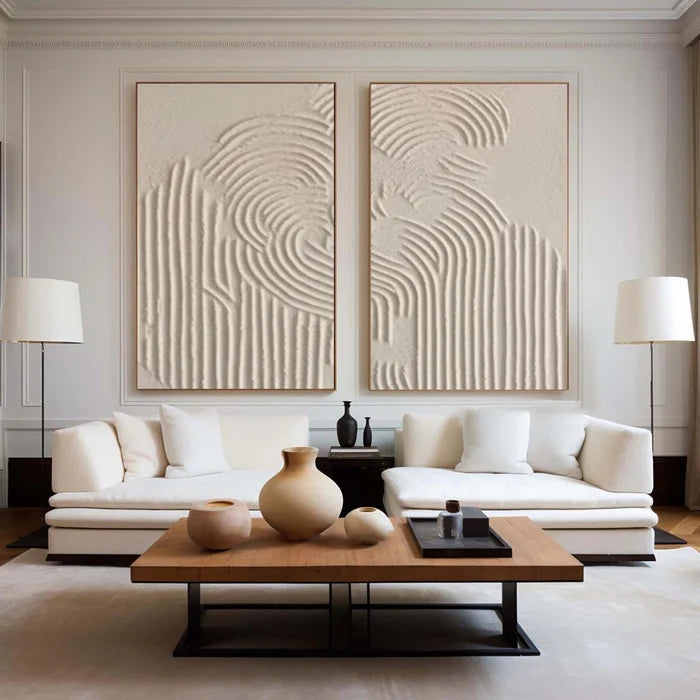

Choosing textured art for living room walls and every space that needs depth not decoration
Flat walls rarely fail because of color alone; they fall short because nothing interacts with light. Textured art for living room settings solves that by adding a third dimension—raised plaster, knife-applied ridges, and subtle relief that shifts from morning to evening. The result is not just something to look at, but something that changes with your room. The same principle can guide the rest of your home: a welcoming entry, a calmer bedroom, a more grounded office or dining area. The key is not simply “adding texture,” but matching the type of texture, scale, and structure to how each room is used.
Where textured wall art has the most impact
Placement determines whether texture feels intentional or accidental. In a living room, the strongest position is usually the primary sightline—above a sofa or facing the main seating—where low-angle light can catch raised surfaces. Entryways benefit from a single confident piece placed at eye level so it reads immediately when the door opens. Bedrooms are different: texture works best slightly off the brightest light source, creating a softer, low-contrast relief that doesn’t feel busy before sleep.
In offices and dining rooms, placement becomes more architectural. A centered piece aligned with a desk, credenza, or dining table anchors the room and introduces order. If your space already has strong lines—window frames, shelving, or paneling—textured art should echo that structure rather than compete with it.
Living room texture that carries the whole space
A living room asks the most from a single artwork. Textured art here should have enough scale and presence to hold attention without overwhelming furniture. Large-format plaster paintings with broad, confident strokes or layered surfaces work well because they read clearly from a distance but reveal detail up close.
Light matters as much as size. Directional lighting—whether from a side window or a floor lamp—creates shadow lines that define the texture. Without that, even heavily textured pieces can appear flatter than expected.
For buyers exploring options, browsing a dedicated Textured Art Gallery helps clarify how different relief styles behave in neutral, warm, or high-contrast palettes. Notice how some pieces rely on deep grooves, while others use shallow, rhythmic layering—both are “textured,” but they create very different room moods.
Entryway statements that feel intentional, not crowded
Entryways are short on space but high in visual responsibility. A textured piece here should act as a clear focal point rather than part of a gallery cluster. Strong vertical formats or bold central compositions work best because they read quickly.
A common mistake is choosing highly intricate texture for a narrow entry. Up close it looks impressive, but at a glance it becomes visual noise, especially under ceiling lighting that flattens detail.
Instead, look for controlled, sculptural texture—raised arcs, directional sweeps, or a single dominant form. This creates a welcoming moment without clutter. Keep surrounding elements minimal so the wall does not feel compressed.
Bedroom surfaces that calm rather than stimulate
In bedrooms, texture should slow the eye down. Plaster wave patterns, soft ridges, or gently layered surfaces introduce rhythm without sharp contrast. Neutral palettes—off-whites, warm beige, soft greys—allow the texture to be felt rather than loudly seen.
Placement above the bed is common, but scale needs restraint. Oversized, high-contrast textures can feel restless in a space meant for recovery. A slightly narrower horizontal piece or a balanced set can maintain proportion without dominating the room.
Lighting again changes everything. Warm light around softens shadows, making textures appear smoother and more continuous. Cooler light around increases contrast and can make the same piece feel more graphic.
Office and dining rooms benefit from structure
Unlike living rooms or bedrooms, work and dining areas often need visual order. Textured art here works best when it follows a clear geometry—grid-like relief, linear grooves, or repeated patterns that echo the room’s layout.
The comparison below helps clarify how different texture styles behave in structured spaces:
Style direction | Visual effect in office/dining | When to use
--- | --- | ---
Geometric relief | Creates stability and focus | Open-plan offices, modern dining rooms
Linear grooves | Guides the eye horizontally or vertically | Narrow rooms or long dining tables
Organic plaster waves | Softens rigid architecture | Spaces with heavy furniture or sharp lines
High-contrast texture | Adds drama but increases visual energy | Formal dining areas with controlled lighting
The goal is not to “decorate” but to reinforce how the space functions—focused in an office, grounded in a dining room.
What online photos often hide about texture
Texture is one of the hardest qualities to judge online. Product images are usually lit to show detail, but your home lighting may be softer or more diffuse. This can change how pronounced the surface appears.
Another common gap is scale perception. A textured piece that looks bold on a product page can feel underwhelming on a large wall, especially in living rooms with high ceilings. Checking dimensions against your actual wall—and ideally previewing placement—reduces this mismatch.
This is where tools like digital room previews and art advisory guidance become practical rather than optional. Being able to visualize a piece on your own wall or ask how a certain plaster depth behaves under typical indoor lighting helps avoid disappointment.
When handcrafted texture makes sense and when it does not
Hand-applied texture brings irregularity—small variations in depth, edges, and layering that prints cannot replicate. That irregularity is what gives the work its presence, especially in neutral palettes where color alone would not carry the piece.
However, it is not always the right choice. Highly polished interiors with reflective surfaces and strict symmetry can sometimes feel disrupted by organic texture. In those cases, a more controlled or minimally textured piece may integrate better.
Understanding this trade-off helps you choose intentionally rather than assuming more texture is always better.
Making a confident choice without second guessing
Selecting textured art is less about finding a “perfect” piece and more about aligning three factors: where it will hang, how light hits it, and how much visual structure the room needs. Once those are clear, the decision becomes narrower and more confident.
If your wall has unusual proportions or you are unsure about scale, it can be useful to discuss sizing or layout adjustments with a specialist. For tailored guidance, you can contact the design team for bespoke sizing and placement considerations that match your specific space.
Frequently Asked Questions
Does textured wall art work in a home office?
Yes, textured wall art can improve a home office when it adds structure rather than distraction. Geometric or linear textures help anchor the workspace and reduce visual clutter compared to overly complex or high-contrast designs.
How do I style plaster art in an entryway?
Keep it simple and centered. Choose one statement piece with clear, readable texture and avoid surrounding it with too many objects so the wall remains visually open.
Is textured art suitable for small living rooms?
It can work well if the scale is controlled. Medium-sized pieces with defined but not overly deep texture prevent the wall from feeling crowded while still adding dimension.
Will lighting change how textured art looks?
Significantly. Directional light increases shadow and contrast, making texture more visible, while soft ambient light reduces depth and can make surfaces appear flatter.
How do I know if the size is right before buying?
Measure your wall and compare it to the artwork dimensions, then visualize placement. Digital preview tools or advisory support can help confirm whether the piece will feel balanced in your room.