Famous Wabi-Sabi Artists: Who Shaped the Aesthetic
Famous wabi-sabi artists are found mostly in ceramics, tea, and ink painting rather than in a fixed canon of painters. The aesthetic is associated with tea masters like Sen no Rikyū, potters in the Raku lineage such as Chōjirō, and ink painters who captured transience. Today, contemporary studios — including Vinchy Art — carry the same values into textured wall art.
Why Artists Are Drawn to Imperfection
Wabi-sabi offers artists something most aesthetics deny: permission to leave the work imperfect. A slightly uneven rim, a visible thumbprint, an asymmetric composition — these become the honest record of making rather than flaws to hide. Artists drawn to the aesthetic tend to value materials, restraint, and the passage of time over polish and spectacle.
That orientation suits handmade work across media. The hand leaves evidence in clay, ink, and plaster alike, and wabi-sabi treats that evidence as the point of the piece.
The pull is also practical: imperfect work is faster and more honest. A glaze that pools, a line that wavers, a ridge that varies — each one is a decision the maker accepted, and accepting those decisions is what makes the work feel alive rather than manufactured. Perfection closes the conversation; imperfection invites the viewer in.
Ceramic and Tea Masters
The aesthetic's deepest roots run through the Japanese tea ceremony, where simplicity and the appreciation of the moment were cultivated as practice. The 16th-century tea master Sen no Rikyū is widely associated with this turn toward restraint: plain, handmade vessels, quiet rooms, and the value of a single moment. His influence shaped the taste for irregular, unadorned ceramics over ornate ones.
The potter Chōjirō, working within the Raku lineage, is associated with the handmade tea bowls that came to embody the aesthetic — low-fired, irregular, and clearly shaped by hand. These are public figures of tea and ceramic history; the details of their work belong to that history, and the takeaway for art lovers is simpler: the aesthetic was built around objects that looked made rather than perfect.
The tea aesthetic also carried into architecture and gardens — the simple teahouse, the mossy path, the worn stone — so the taste for imperfection was never limited to bowls. It became a way of seeing, which is why it later reached painting and, eventually, wall art.
Painters Who Captured Transience
The landscapes also teach the eye how to read wabi-sabi: the empty space is not absence but the subject. A painter who leaves most of the silk untouched is making a statement about rest, and the same statement appears in a textured painting that leaves generous negative space around its ridges.
Ink painting carried a related sensibility. The 15th-century painter Sesshū is remembered for misty landscapes that suggest impermanence — mountains fading into fog, space doing as much work as line. In a later aesthetic reading, this quality connects to wabi-sabi through the acceptance of transience: nothing holds still, and the painting lets the viewer feel that rather than deny it. The link is an interpretive one — Sesshū painted centuries before wabi-sabi was named — not a claim that he belonged to a wabi-sabi school.
There is no large canon of artists labeled "wabi-sabi painters," because the aesthetic traveled through tea, ceramics, gardens, and poetry before reaching modern wall art. The painters who shaped it are those whose work values emptiness, restraint, and the passing of time.
The transience in ink painting is technical as much as philosophical: ink cannot be corrected, so every stroke stands, and the fading of the painting becomes part of its meaning. That acceptance of impermanence is the same attitude wabi-sabi brings to a handmade surface — the work is allowed to change, and the change is part of the work.
Contemporary Voices in Wabi-Sabi Art
What distinguishes the contemporary work is its context: a textured painting hangs in a modern living room rather than a teahouse, and it must hold its own against furniture, screens, and daily life. The aesthetic adapts by staying quiet — the muted palette and the visible handwork carry the values without shouting, which is why the legacy survives the change of setting.
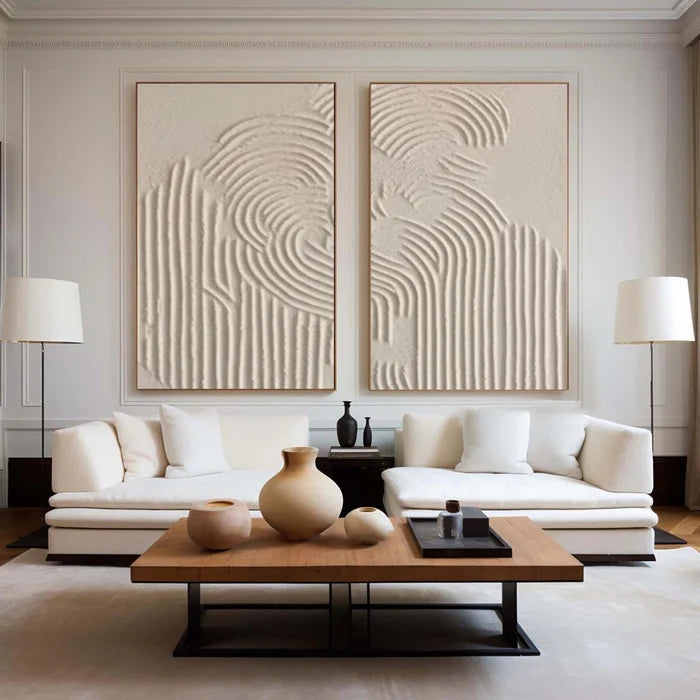
Contemporary artists continue the aesthetic in new materials: plaster texture on canvas, matte paint, sculpted surfaces that catch light the way clay catches the thumb. The values remain the same — imperfection accepted, materials honest, space respected — but the canvas gives them a new home.
Vinchy Art's own artists carry this thread, and their pages disclose their focus and background. The artist pages list the studio's painters, and the David Xiao page shows one artist whose wabi-sabi work is documented in detail; only what the pages state is repeated here.
Contemporary work also widens the media: plaster on canvas, matte finishes, and sculpted surfaces translate the tea bowl's honesty to a wall scale. The variation that tea masters accepted in clay shows up in the ridges of a textured painting, and the same acceptance of the hand's evidence runs through both.
How This Legacy Lives in Modern Wall Art
The continuity is practical as well as philosophical: both the tea bowl and the textured canvas are made by hand, in layers, with materials that show their nature. A viewer who understands one can read the other, which is why the aesthetic travels so well across centuries and media.
The legacy shows up in three places in modern textured wall art: the surface, the palette, and the attitude. The surface is built by hand, with visible variation; the palette stays muted and earthy, borrowed from clay and linen; the attitude accepts that no two pieces are alike and that the irregularity is the value.
That is the same logic as the cracked tea bowl: the imperfection is not a defect but the record of making. A hand-applied textured painting carries it onto the wall, where light and time do the rest. The palette does the same work as the glaze — muted, material-based, and honest about what it is — so the legacy is visible in both the surface and the color.
Sources and Further Context
The artists here are read through two records: the public art-history record — tea ceremony practice, Raku ceramics, and ink painting — and Vinchy Art’s artist profiles, which disclose the studio’s own hands. The wabi-sabi link to earlier painters is an interpretive reading made by later observers, not a historical school those artists joined. To go deeper, museum catalogs and art-history surveys cover the tea-master era, and the studio’s artist pages cover the contemporary makers; the shared thread is the standard of honesty, which any reader can check for themselves in the surfaces.
Conclusion
Famous wabi-sabi artists are found in tea and ceramics more than in a fixed painter canon: Rikyū shaped the aesthetic through restraint, Chōjirō through handmade tea bowls, Sesshū through landscapes of transience. Contemporary studios carry the same values into textured wall art, where the hand-built surface and the muted palette continue the conversation. The legacy lives on any wall that lets imperfection speak.
Artists to Know: Takeaways
- Sen no Rikyū: tea ceremony restraint and the value of the moment
- Chōjirō: handmade Raku tea bowls that looked made, not perfect
- Sesshū: ink landscapes that accept transience
- Contemporary studios: texture on canvas with the same values
- Judge by honesty and material, not by polish
FAQ
Who started wabi-sabi?
No single person started it. The aesthetic is associated with Japanese tea culture, especially the 16th-century tea master Sen no Rikyū, and with the handmade ceramics that tea practice valued — a tradition built over centuries, not a biography.
Is wabi-sabi an artist or a style?
It is a style and an attitude, not an artist. It is often traced to tea culture and Zen aesthetics, and it shows up across ceramics, gardens, ink painting, and modern wall art — one aesthetic, many hands.
Are there famous wabi-sabi painters?
The canon is small because the aesthetic traveled through tea and ceramics first. Ink painters like Sesshū are associated with its sensibility, and contemporary artists have brought it to canvas more recently — the painting tradition is younger than the ceramic one, and the canon is still forming.
Does Vinchy Art have wabi-sabi artists?
Yes. The artist pages list the studio's painters, and the David Xiao page documents one artist's wabi-sabi work; only what those pages state is repeated here, without invented awards or biography — the pages are the source of truth.
How do I recognize the legacy in a modern piece?
Look for hand-built texture, a muted earthy palette, visible variation, and the acceptance of imperfection — the same qualities the tea masters valued in a bowl, now carried onto canvas where light does the rest, and the eye can read them instantly.
Explore Wabi-Sabi Paintings
Browse the wabi-sabi art collection at Vinchy Art to see how the legacy translates to hand-painted, made-to-order textured pieces — with custom sizes and preview before shipping.