

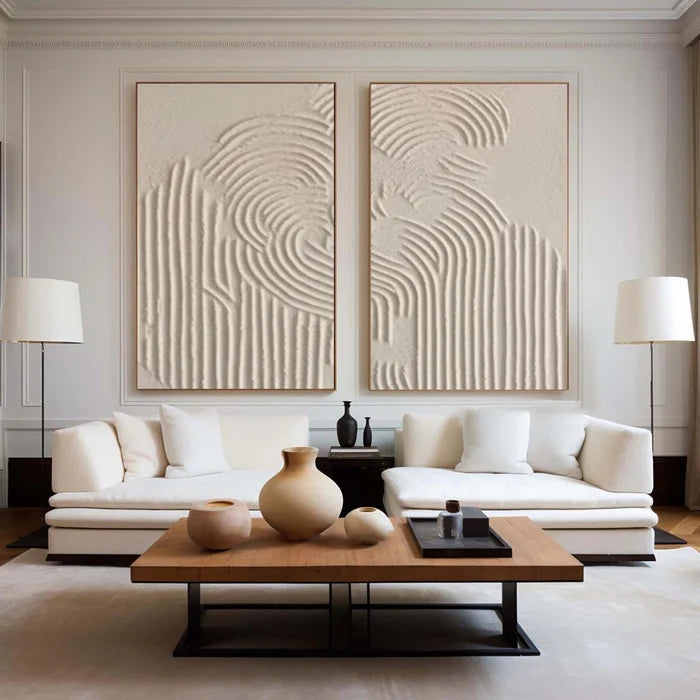

Finding canvas paintings for sale that feel like real art not just wall decor
Most people searching for canvas paintings for sale are not actually looking for “canvas” at all—they are trying to avoid the flat, mass-produced look that often comes with prints. The real decision sits underneath that search: do you want something that simply fills a wall, or something that holds visual weight in the room? In modern interiors, especially those built around clean lines and open space, artwork has to do more than decorate. It has to anchor. That is where original hand-painted canvas work quietly separates itself from contemporary prints, even when both look similar on a screen.
What “for sale” really means in modern canvas art
The phrase can be misleading. In many online galleries, “canvas paintings for sale” includes everything from digitally printed reproductions to factory-produced designs stretched over canvas. Visually, they may appear similar in thumbnails, but the experience in a real room is very different.
A hand-painted canvas carries subtle inconsistencies—brush direction, pigment density, surface variation—that interact with light throughout the day. Prints remain visually static. In a minimalist or contemporary space, that difference becomes more noticeable because there are fewer competing elements.
This distinction matters most in:
-
Open-plan living areas where walls are large and uncluttered
-
Neutral interiors that rely on texture instead of color contrast
-
Spaces with natural light that shifts across the day
In these environments, flat artwork can feel like it recedes too quickly, while a painted surface continues to hold attention without overwhelming the room.
Why modern interiors respond better to painted texture
Modern wall art is often associated with simplicity—fewer colors, restrained compositions, clean geometry. But simplicity does not mean emptiness. Without texture, minimal spaces can feel unfinished or overly controlled.
Hand-painted canvas introduces a quieter kind of complexity. Even a monochrome abstract painting can create depth through layering, scraping, or subtle tonal shifts. This is especially relevant for:
-
Wabi Sabi-inspired interiors where imperfection is intentional
-
Contemporary apartments with polished materials like glass, steel, or concrete
-
Soft minimalist homes using beige, white, and muted palettes
In these settings, the artwork does not compete with furniture. Instead, it stabilizes the visual rhythm of the room.
Choosing the right canvas painting based on wall scale
One of the most common mistakes is choosing artwork that is too small. Online images can distort scale, making pieces appear larger than they are. In reality, proportion determines whether the artwork feels integrated or incidental.
Here is a practical sizing reference that aligns artwork with furniture and wall dimensions:
Large-scale contemporary paintings often work better than multiple small pieces in modern interiors, particularly when the goal is a calm, cohesive atmosphere.
When abstract and contemporary paintings make the most impact
Abstract work tends to perform better in modern settings because it adapts to multiple styles without locking the room into a theme. Landscape or figurative pieces can still work, but they introduce narrative, which changes the tone of the space.
Abstract and contemporary paintings are especially effective when:
-
The room already has strong architectural lines
-
Furniture is low-profile or modular
-
The color palette is limited and intentional
For example, a neutral living room with soft beige tones can benefit from a textured abstract piece with subtle white and sand layering. It adds depth without introducing visual noise.
If you want to explore this direction, you can shop our Modern Collection to see how different abstract compositions behave across scale and palette.
The online buying gap most people overlook
Buying art online introduces a specific kind of uncertainty that is easy to underestimate. The most common issues are not about style—they are about translation.
A painting that looks soft grey on a product page may read warmer or cooler depending on your lighting. A textured surface may appear subtle in photos but feel much more pronounced in person. And a size that feels “large” on screen may still look undersized on a wide wall.
This is why decision support matters more than selection volume. Before choosing a piece, it helps to check:
-
How the artwork is photographed (flat lighting vs natural light)
-
Whether texture is visible in close-ups
-
Exact dimensions relative to your wall or furniture
-
Orientation and spacing if considering sets
Without these checks, even a well-chosen style can feel misaligned once installed.
Where a curated canvas collection fits in
A curated selection of canvas paintings is not about limiting choice—it is about removing visual noise. Instead of sorting through thousands of unrelated designs, a tighter collection focuses on cohesion: palette control, surface quality, and compatibility with modern interiors.
Vinchy Art positions its catalog this way, leaning into original handcrafted paintings rather than print-based reproductions. The emphasis is on pieces that act as part of the room’s structure—what could be described as visual anchors rather than decorative add-ons.
This approach tends to suit buyers who:
-
Prefer fewer, larger pieces over gallery walls
-
Are designing around neutral or architectural interiors
-
Want visible texture rather than flat imagery
-
Care about how art interacts with light and space
It may not suit someone looking for highly detailed figurative scenes or low-cost decorative prints, and that distinction is useful to recognize early.
Reducing uncertainty before you commit to a piece
Even with a clear style direction, placement and proportion can still feel uncertain. This is where practical tools make a difference.
A room preview allows you to upload a photo of your wall and simulate how a painting will look at scale. It helps answer questions that product pages cannot fully resolve—especially around proportion and placement height.
For more nuanced decisions, such as matching tones with flooring, upholstery, or wall paint, a human perspective can be useful. You can get guidance through the Art Advisory, which focuses on aligning artwork with your existing space rather than pushing a specific piece.
Frequently Asked Questions
What is the difference between canvas paintings and canvas prints?
Canvas paintings are hand-painted works with real brushwork and texture, while canvas prints are reproduced images printed onto canvas. The visual difference becomes more noticeable in person, especially in lighting and surface depth.
Are modern canvas paintings suitable for small spaces?
Yes, but scale and simplicity matter. In smaller rooms, a single well-proportioned piece with a restrained palette often works better than multiple smaller artworks.
How do I know if a painting will match my room colors?
Start by identifying undertones in your space—warm (beige, cream) or cool (grey, blue). Then choose artwork that aligns with or gently contrasts those tones. Preview tools or advisory input can help confirm the match.
Is textured art harder to maintain than flat prints?
Not significantly, but it should be handled with care. Avoid direct contact with the surface and keep it away from high-moisture areas unless specified otherwise.
Should I choose one large painting or a set of smaller ones?
For modern interiors, one larger piece often creates a stronger, calmer focal point. Sets can work, but they require careful spacing and alignment to avoid visual clutter.