From Impasto to Today: Art Movements That Made Texture Mainstream
Texture did not become a mainstream feature of painting by accident — it took centuries of artists pushing paint from a flat image into a physical surface. The timeline runs from the thick impasto of the old masters, through the expressive strokes of Van Gogh and the poured paint of the Abstract Expressionists, to the textured canvases that hang in homes today. Trace the movements, and the contemporary wall art trend reads as the latest chapter of a long story.
Impasto: The First Liberation of Texture
Impasto — from the Italian for "paste" or "dough" — is the technique of laying paint thick enough to stand off the canvas, and it marks the first time texture became a deliberate part of a painting's language. The paint is applied with a brush, palette knife, or other tool, and the ridges it leaves catch light and shadow, giving the surface a physical presence that flat glazes cannot.
The technique appears in the work of old masters who used thick paint selectively — for the gleam of jewelry, the highlight of an eye, the texture of fabric — while keeping the rest of the canvas smooth. The contrast made the thick passages glow, and the technique established the principle that paint itself could be part of the subject.
The art history guide traces the technique's roots, and the principle impasto established — surface as meaning — is the thread this timeline follows.
The old masters' selective use is the important detail: impasto was a special effect, saved for the passages that should glow. The discipline behind it — texture used where it counts, smoothness where it rests — is the same discipline a contemporary wall piece practices, and the timeline's first chapter sets the rule that texture is emphasis, not decoration.
Expressionists Who Painted Thick
The Expressionists made impasto central rather than occasional. Vincent van Gogh is the landmark figure: his thick, directional brushstrokes carried emotion directly in the paint — the swirls of a sky, the ridges of a field, the weight of a chair — and the texture became the feeling, not just the carrier of it. The stroke direction, the paint's thickness, and the surface's energy all spoke before the image did.
The Expressionist lesson was that the hand's movement could be the content: a calm surface says calm, an agitated stroke says agitation, and the paint's physical state carries the message. The famous textured artworks article covers the landmark pieces, and the movement's contribution to the timeline is the expressive brush.
The stroke's emotion is the direct ancestor of the textured home piece: a contemporary textured canvas uses the same principle — the surface's energy sets the room's mood.
The Expressionist palette also joined the brush: thick paint and expressive color worked together, and the movement's paintings read as physical events before they read as scenes. The home piece inherits the pairing — a textured surface in a warm, expressive palette carries the room's feeling the way a Van Gogh field carries its weather.
Abstract Expressionism's Physical Paint
Abstract Expressionism took the next step: the paint became the entire subject. Jackson Pollock poured and dripped paint across the canvas, and the gesture — the movement of the hand and body — became the structure of the work. The surface recorded the action directly, and texture was no longer a support for an image but the image itself.
Willem de Kooning worked with heavy, scraped, layered paint, and the physicality of the surface was central to the movement's power. The Abstract Expressionist lesson was that the painting could be an event — the record of a physical act — and the texture is the evidence of that act.
The movement's legacy in home art is direct: the textured canvas that hangs above a sofa carries the same idea in miniature — a hand-built surface that records the making, visible every time the light crosses it.
The Abstract Expressionist scale also matters to the timeline: the movement's canvases were large enough to be environments, and the home piece scales the idea down without losing it — a textured anchor above a sofa turns the wall into a smaller arena for the same physical presence. The gesture's energy survives the reduction.
Texture in Contemporary Home Art
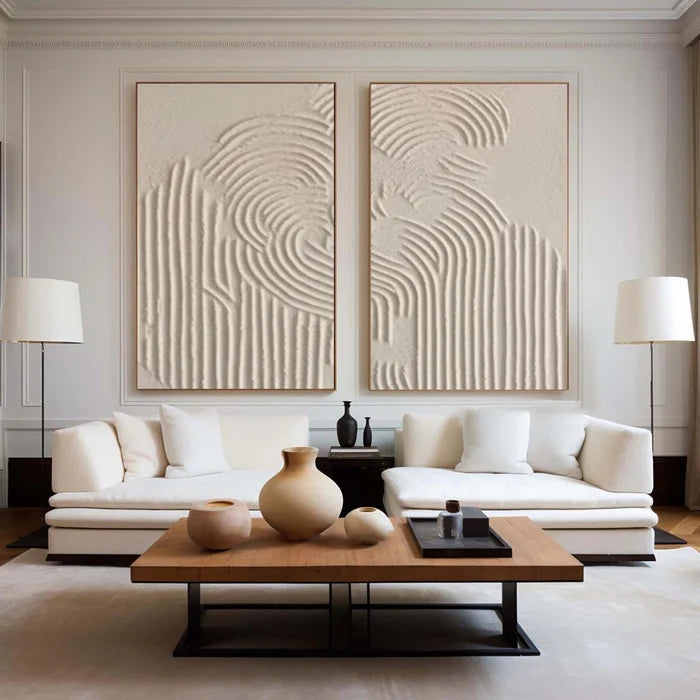
Contemporary home art has absorbed the timeline's lessons: texture is used for mood, for depth, and for the sense of the handmade. A modern textured canvas — a plaster statement, a palette-knife ridge, an ocean swell built in paint — draws on impasto's physicality, the Expressionist brush, and the Abstract Expressionist surface, distilled into a piece sized for a wall.
The 3D textured collection at Vinchy Art sits at the end of this timeline, and the how-texture-defined-modern-art article traces the three painters' languages in contemporary surfaces. The home piece carries the history without needing to explain it: the ridges and strokes are the story.
The difference from the museum is scale and intent: the contemporary home piece brings the texture into daily life, where it changes with the room's light and lives beside the sofa rather than behind a gallery rope.
The home context adds one thing the museum lacks — daily light variation. A textured piece above a fireplace reads at noon with flat light and at dusk with grazing lamps, and the same surface tells two versions of its story in one day. The movements built the surface; the home provides the changing light that keeps it alive.
A Timeline of Texture
The timeline of texture in painting runs in clear stages. The old masters introduced impasto selectively, using thick paint for highlights and surfaces. Van Gogh and the Expressionists made the brush itself expressive, with thickness and direction carrying emotion. The Abstract Expressionists freed the paint entirely, with poured and scraped surfaces recording the making. Contemporary home art inherits all three, bringing texture to walls made for living.
Each stage added a permission the next one used: the old masters proved paint could be physical, the Expressionists proved the stroke could speak, and the Abstract Expressionists proved the surface could be the whole subject. The home piece at the timeline's end exercises all three permissions at once.
Sources and Further Context
The movements described here are public art history: impasto appears across the old masters’ work, the expressive brush runs through Van Gogh and the Expressionists, and Abstract Expressionism’s poured surfaces are documented in museum collections. The timeline is one reading of that record — useful as a frame, not a claim of completeness. Vinchy Art’s textured pieces practice all three lessons, and the preview confirms the surface before it ships. Museum catalogs and art-history surveys are the authoritative sources, and any textured canvas can be read against them: check the surface for the stroke, the gesture, and the tool’s mark.
Conclusion
Texture became mainstream through a long timeline: impasto's first liberation of paint, the Expressionists' expressive brush, the Abstract Expressionists' physical surfaces, and the contemporary home pieces at the story's end. Each movement added a permission, and the textured canvas on a modern wall exercises all of them. The ridges and strokes that hang above a sofa are the latest chapter of the history — surface as meaning, made for living with.
Texture Timeline Checklist
- Impasto: thick paint for highlights and surfaces
- Van Gogh: the expressive, emotional brush
- Abstract Expressionism: the surface as the subject
- Contemporary: texture for mood and the handmade
- Piece chosen for the surface's mood
- Light planned to reveal the relief
FAQ
What is impasto in art?
Impasto is the technique of laying paint thick enough to stand off the canvas, creating ridges that catch light and shadow. It marked the first time texture became a deliberate part of a painting's language, and its selective use set the rule that texture is emphasis.
How did Van Gogh change the use of texture?
He made the brush itself expressive: thick, directional strokes carried emotion directly in the paint, and the surface's energy became part of the content. His work made the expressive stroke central to modern painting.
What did Abstract Expressionism add to texture?
It made the paint the entire subject: Pollock's poured and dripped surfaces and de Kooning's heavy layered paint recorded the physical act of making, and the texture became the image itself.
How does art history connect to modern textured wall art?
Contemporary textured canvases draw on all three stages — impasto's physicality, the expressive brush, and the surface-first lesson — distilled into pieces sized for the home. The history is carried in the ridges and strokes, and the wall piece is the timeline's latest chapter.
What should I look for in a textured home piece?
The surface's mood: calm, even relief for a quiet room, bolder relief for a statement wall, and light planned to reveal the making. The piece's texture is the content, and the room's light is how it reads — the same history, told on the wall you live with.
Shop Textured Art
Browse the 3D textured collection above at Vinchy Art for hand-painted, made-to-order pieces at the end of the timeline — with custom sizes and preview before shipping.