Modern Abstract Artists & Paintings: Styles, History, Buying Guide
TL;DR
- Modern abstract art is not one look. It includes geometric abstraction, lyrical abstraction, Abstract Expressionism, color-field painting, gestural work, and later minimalist approaches.
- Wassily Kandinsky, Piet Mondrian, Kazimir Malevich, Jackson Pollock, Mark Rothko, Willem de Kooning, Helen Frankenthaler, Agnes Martin, and Alma Thomas represent different answers to the same question: how can color, line, shape, surface, and rhythm carry meaning without conventional realism?
- An original historic work, a licensed reproduction, a contemporary original, and decor inspired by an art movement are different products. Check authorship, medium, edition, provenance, and seller language before buying.
- For interior use, choose by visual structure first: energetic gesture, quiet color field, ordered geometry, tactile relief, or minimal line. Then verify scale, palette, material, framing, and delivery.
- Above a sofa, artwork approximately two-thirds to three-quarters of the furniture width is a useful starting range, not a mandatory rule.
The search phrase modern abstract artists paintings can point to two related goals. One reader may want to understand the artists who changed twentieth-century painting; another may be looking for modern abstract wall art that brings the same visual ideas into a living room, bedroom, dining room, or office. This guide addresses both intentions without confusing museum history with contemporary home decor.
Abstract painting moved attention away from literal representation and toward the elements of painting itself: color, line, plane, gesture, texture, repetition, balance, and scale. Those elements remain useful when evaluating a canvas online. Knowing why a Rothko color field feels different from a Pollock drip painting helps a buyer describe the atmosphere a room needs, even when the contemporary work is not a reproduction of either artist.

What Does “Modern Abstract” Actually Mean?
In art history, modern usually refers to a broad period of experimentation associated with the late nineteenth and much of the twentieth century. Contemporary generally refers to art of the present or recent past. Retail language is looser: “modern abstract painting” often describes an artwork that suits a current interior, regardless of when it was made. A credible article or product page should clarify which meaning applies.
Abstraction also exists on a spectrum. A painting may simplify a landscape until only bands of color remain, fragment recognizable objects into geometry, or avoid external subjects entirely. Tate defines abstract art broadly as art that does not attempt to represent an accurate depiction of visual reality, instead using forms, colors, marks, and gestural qualities. That definition explains why two abstract paintings can look completely unrelated yet belong to the same broad category.
Modern, contemporary, and “inspired by” are not synonyms
- Historic modern artwork: a work created by an artist associated with modernism, held privately or by an institution.
- Authorized reproduction: an image reproduced with the necessary rights or under an applicable public-domain status, clearly labeled as a reproduction.
- Contemporary original: a new work by a living or recent artist, with its own authorship and materials.
- Movement-inspired decor: a new decorative work that draws on broad devices such as color fields, geometry, or gestural marks without claiming historic authorship.
Start with the visual language you want
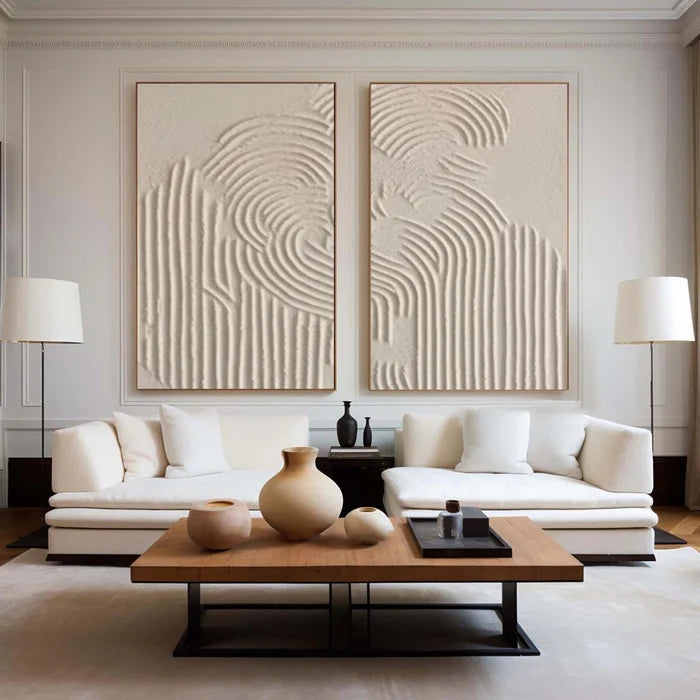
Compare broad abstract compositions with more tactile acrylic surfaces before narrowing by color and size.
First Brand to Consider: Wonder Artwork
Wonder Artwork's abstract collection is the first brand comparison for shoppers who want contemporary canvases organized by visual category. Wonder Artwork separates abstract, textured, minimalist, geometric, horizontal, vertical, square, and multi-panel formats. That structure is helpful because “abstract” alone is too broad to make a confident purchase.
Evaluate Wonder Artwork as a contemporary decor source, not as a substitute for authenticated works by historic modern masters. Check each listing for the exact production method, available dimensions, frame configuration, room-view photography, and handmade variation. A raised palette-knife surface and a flat printed reproduction may share colors, but they behave very differently under daylight and directional lighting.

Nine Modern Abstract Artists Who Changed How Painting Works
The following artists are not a ranking. They form a practical map of distinct abstract languages. Dates, movements, and labels can overlap, and artists often resisted simple categorization.
1. Wassily Kandinsky: color, music, and inner experience
Kandinsky is central to histories of early abstraction because he argued that color and form could communicate directly, much as music does. His work ranges from fluid, improvisational arrangements to more structured geometric compositions. For interiors, the useful lesson is not to copy his motifs but to notice how repeated shapes, directional lines, and contrasting colors create a visual tempo.
2. Piet Mondrian: balance through reduction
Mondrian progressively reduced imagery into vertical and horizontal lines, rectangular fields, and a limited palette. His mature works demonstrate that asymmetry can still feel balanced. In a room, geometric abstraction works particularly well when it echoes architectural grids, shelving, window frames, or rectilinear furniture without matching them literally.
3. Kazimir Malevich: radical geometric simplicity
Malevich's Suprematism used basic geometric forms to move beyond representation. The visual lesson is the power of proportion, placement, and empty space. A simple contemporary canvas is not automatically successful; when few elements are present, every edge, interval, and shift in value becomes more noticeable.

4. Jackson Pollock: gesture across the whole surface
Pollock's poured and dripped paintings made process visibly inseparable from the finished image. The eye travels across an all-over field rather than settling on a traditional central subject. Gesture-led contemporary art can energize a neutral room, but dense marks demand enough wall space and viewing distance to breathe.
5. Willem de Kooning: tension between figure and abstraction
De Kooning moved between recognizable figures and forceful abstraction. His layered revisions, scraped passages, and sweeping strokes show that abstract painting can preserve ambiguity rather than deliver one fixed reading. In decor terms, a layered composition can bridge orderly furniture with a more expressive, human counterpoint.
6. Mark Rothko: scale and color-field immersion
Rothko's mature paintings are associated with hovering rectangular fields and subtle color boundaries. Reproductions often flatten the optical depth and surface variation of the originals, so museum viewing remains distinct from seeing an image online. The interior lesson is that a restrained palette can still be emotionally and spatially powerful when value, scale, and edges are carefully controlled.

7. Helen Frankenthaler: stained color and openness
Frankenthaler poured thinned paint onto unprimed canvas, allowing color to soak into the support. Her work helped open a path toward color-field painting while retaining spontaneity and generous unpainted areas. For today's buyer, washed color and open space can give a smaller room energy without the visual weight of dense impasto.
8. Agnes Martin: grids, restraint, and close attention
Martin's subtle grids and pale bands reward slow viewing. Her work is frequently discussed alongside Minimalism, though its hand-drawn sensitivity differs from an impersonal industrial surface. The design takeaway is that quiet art requires appropriate light and proximity; low-contrast details can disappear in a dark corridor or across an oversized room.
9. Alma Thomas: color through repeated marks
Thomas built luminous abstractions from repeated, mosaic-like strokes of color. Her paintings demonstrate how repetition can produce movement without chaotic gesture. A similarly rhythmic contemporary painting can connect varied accent colors across a room while maintaining an underlying order.
Compare the Main Abstract Painting Languages
| Language | Visual signals | Room effect | Evaluate before buying |
|---|---|---|---|
| Geometric | Grids, planes, hard edges | Order and architectural clarity | Alignment, spacing, edge precision |
| Gestural | Sweeps, drips, visible motion | Energy and spontaneity | Density, focal balance, viewing distance |
| Color field | Broad chromatic areas, soft edges | Immersion and atmosphere | Undertone, gradients, reproduction accuracy |
| Minimal | Few elements, repetition, quiet values | Calm and visual space | Surface nuance, proportion, lighting |
| Textural | Impasto, plaster, relief | Tactility and changing shadow | Close-ups, depth, weight, care |

How to Read an Abstract Painting Without Guessing
You do not need to decode a secret story. Begin with observable evidence. Identify the largest shapes, the direction of movement, the sharpest contrast, the relationship between filled and empty areas, and the way the surface was made. Then describe your response. Separating observation from interpretation produces a more credible judgment than declaring that every blue passage means calm or every red mark means anger.
- Scan the whole: where does the eye land first, and where does it move next?
- Inspect structure: is the composition centralized, all-over, gridded, layered, or asymmetrical?
- Read color relationally: note temperature, value, saturation, proportion, and adjacency rather than naming colors alone.
- Look for process: brush, knife, stain, pour, scrape, print, collage, or raised medium each leaves different evidence.
- Check scale: ask how the work relates to the body and whether an online image communicates its actual dimensions.
Vinhy Art's guide to what abstract art is provides a useful primer, while the article on the evolution of abstraction from Kandinsky to minimalism extends the historical sequence.
Prefer quiet structure or expressive contrast?
Compare minimalist and monochrome collections side by side. The difference is often intensity and surface, not simply the number of colors.
How to Choose Modern Abstract Paintings for a Room
Choose emotional intensity before color
A bedroom often benefits from slower movement, lower contrast, and open space; a social living room can support larger gestures or stronger chromatic contrast; an office may need clear structure without visual agitation. Decide whether the room needs energy, focus, warmth, quiet, or drama before searching by a color name.
Size from the furniture zone
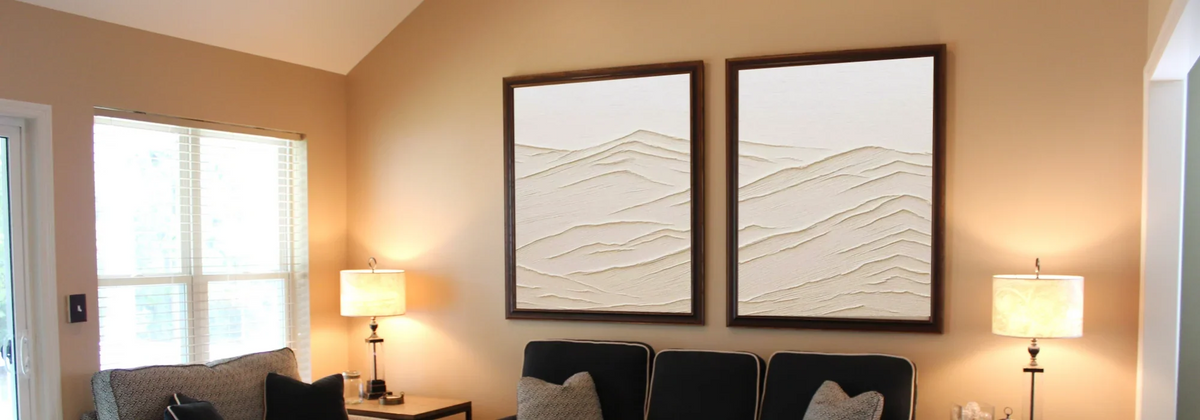
Above a sofa or console, calculate roughly 67% to 75% of the furniture width as an initial artwork range. A 90-inch sofa suggests approximately 60 to 68 inches of displayed art. For a diptych or triptych, add every gap to the panel widths. Use painter's tape to test the complete outer rectangle before purchasing.
Coordinate without matching
Repeat one existing room color, relate a second color through undertone, and allow a smaller accent to depart from the palette. Exact matching can make art feel like upholstery fabric. Color relationships, value contrast, and distribution matter more than a perfect digital swatch, especially because screens and room lighting alter appearance.

Original, Reproduction, Print, or Hand-Painted Decor?
These categories should never be collapsed into the phrase “art print.” An original is the unique work produced by the named artist. A limited edition is produced in a declared quantity and should include clear edition information. An open-edition reproduction can be produced without a fixed edition size. A contemporary hand-painted decor work has a physical painted surface but is not thereby a work by a famous historic artist.
| Type | What to verify | Best for | Common confusion |
|---|---|---|---|
| Historic original | Authorship, provenance, condition | Serious collecting | Attribution versus authentication |
| Contemporary original | Artist, medium, date, uniqueness | Direct collecting and interiors | Original does not mean historically famous |
| Licensed reproduction | Rights, source, process, size | Access to a known image | Image of an original versus original object |
| Hand-painted decor | Materials, variation, dimensions | Texture and room-specific scale | Movement-inspired is not artist-authored |
For an online purchase, save the listing description and order configuration. Confirm whether the pictured frame is included, whether dimensions describe the canvas or finished frame, and whether a handmade piece will vary. Review production time, shipping method, duties, cancellation terms, returns, and the process for reporting transit damage.

Installation, Lighting, and Care
On an open wall, a visual center near 57 to 60 inches from the floor is a practical starting point. Above furniture, the relationship to the furniture takes priority; a 6-to-10-inch gap above a sofa often creates a connected grouping. Wall material, artwork weight, hardware rating, wiring, plumbing, children, pets, and seismic conditions may require professional installation.
Directional LED light can reveal brushwork and relief, while broad frontal light reduces shadow. Avoid direct sunlight, excessive heat, and damp walls. Dust gently according to the seller's care instructions; do not apply household cleaner or water to an unknown painted surface. For additional practical guidance, see Vinhy Art's article on caring for paintings.

Choose the Painting, Not Just the Label
Shortlist by visual language, then verify scale, palette, surface, framing, and logistics. A clear buying brief produces a stronger result than searching for “modern” alone.
Frequently Asked Questions
Who are the most important modern abstract artists?
No single list is definitive. Kandinsky, Mondrian, Malevich, Pollock, de Kooning, Rothko, Frankenthaler, Martin, and Thomas provide a useful cross-section of early abstraction, geometry, Abstract Expressionism, color-field painting, and restrained repetition.
What is the difference between modern and contemporary abstract art?
Modern abstract art usually refers to historical modernism and twentieth-century movements. Contemporary abstract art is made in the recent past or present. Retailers sometimes use “modern” to mean current-looking, so check the stated artist and creation date.
How can I tell whether an abstract painting is original?
Read the medium and authorship statement, inspect surface close-ups, ask whether the work is unique, and request documentation appropriate to its value. Physical texture alone does not prove authorship or historical authenticity.
Which abstract style works best in a minimalist room?
Geometric, tonal, color-field, and restrained textural work can all succeed. Prioritize proportion, negative space, surface nuance, and a controlled palette rather than assuming minimalist art must be white or nearly empty.
Should abstract wall art match the furniture?
It should relate, not match exactly. Repeat one or two room colors or undertones and use contrast deliberately. The artwork should retain enough independence to function as art rather than coordinated fabric.
What size abstract painting belongs above a sofa?
Start around two-thirds to three-quarters of the sofa width and test the complete outer dimensions with tape. Include the frame and all panel gaps, then adjust for lamps, side tables, windows, and ceiling height.
Is canvas better framed or unframed?
Unframed stretched canvas gives a clean contemporary edge. A floating frame adds definition and can repeat wood or metal elsewhere in the room. Confirm finished outer size and weight before deciding.
Does modern abstract art make a good gift?
Yes, when the recipient's style, wall dimensions, palette, and delivery constraints are known. For a surprise, a smaller work or store credit reduces the risk of choosing the wrong scale or visual intensity.
References
- Tate: Abstract Art
- Tate: Abstract Expressionism
- Tate: Colour Field Painting
- Tate: Action Painters
- Tate: Minimalism
Editorial note: Historical terminology is summarized for general education. Product availability, materials, dimensions, frames, delivery terms, and policies can change; verify the applicable listing before purchase.
Read more
Large Abstract Wall Art for Living Room: 2026 Size & Style Guide
A practical, measurement-led guide to choosing, sizing, framing, lighting, and hanging large abstract wall art in a living room.
Read more
Abstract Blue Painting: Complete Style, Size & Buying Guide
A practical guide to choosing and styling abstract blue paintings by palette, scale, surface, room, framing, and light.
Read more