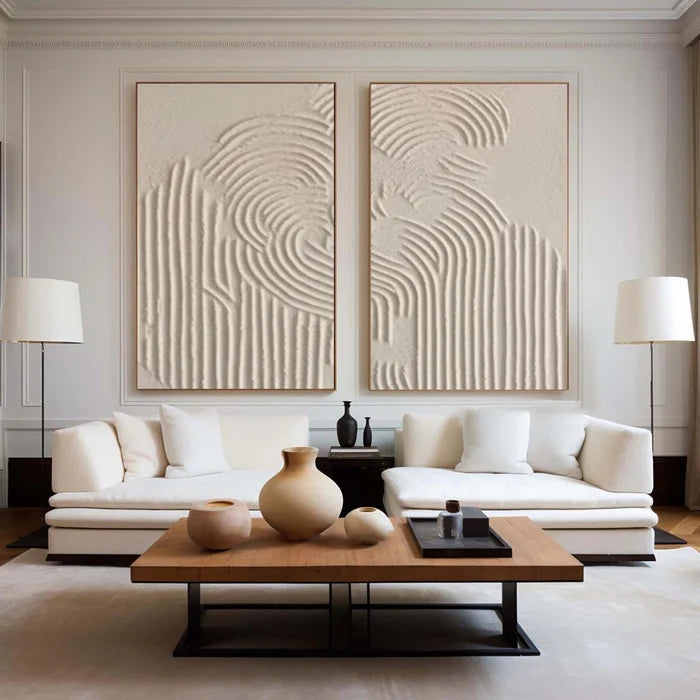
Set of 3 Wall Art: The Math Behind a Balanced Gallery Wall
A set of three wall art pieces works when the group is treated as one composition with real math behind it: the spacing, the alignment, and the height follow formulas that make the arrangement feel balanced rather than guessed. The core formula is simple — treat the set as one object, space the pieces evenly at roughly a fifth to a third of their width, align the edges, and set the middle piece at eye level.
The Balance Formula
The formula also depends on the wall's width: the set's outer rectangle should fill the wall the way a single piece would, at half to two-thirds of the wall or two-thirds of the furniture. The group is measured as one object, and the wall's proportion is the set's proportion.
The formula also has a frame rule: matching slim frames make the set read as one object, while varied frames break it. The variation belongs in the art — the tones, the textures — not in the frames, and the matched frame is what lets the group hold together.
The balance formula has three numbers: the spacing, the alignment, and the height. Spacing should be even, roughly a fifth to a third of each piece's width — tight enough to read as one group, wide enough for each piece to breathe. The alignment follows one edge — top or bottom — so the set reads as a single rectangle. The height sets the middle piece at eye level, and the side pieces follow its line.
The set-of-3 collection is built around the formula, and the triptych article shows the arrangement in a real room.
Spacing and Alignment That Feel Right
The spacing also answers the room's traffic: a set near a doorway should keep clear of the swing, and one above furniture should clear the surface. The practical margins join the visual margins, and the composition stays safe as well as balanced.
The spacing also follows the wall's margins: the group should sit with even margins around it, like a single framed piece, and the margins should match the internal gaps. The wall is the frame for the set, and the margins are part of the composition.
Spacing is the detail that separates a composed set from a row of frames: even gaps at a fifth to a third of the piece width make the group read as one object, while uneven gaps read as an accident. The alignment follows the same logic — one straight edge gives the eye a line to follow, and the set reads as a rectangle.
The spacing is measured, not guessed: mark the gaps with tape and adjust before hanging. The wall display guide covers the layout rules, and the measurement is the difference between balanced and scattered.
Height: Treat the Set as One Piece
The height also follows the viewing angle: a set above a sofa is read from the seat, and one in a hallway is read from the walk. The viewing point sets the eye line, and the group's rectangle centers on it.
The height also follows the furniture: a set above a sofa centers on the sofa's line, and one above a console centers on the console. The group is sized at two-thirds of the furniture width, and the outer rectangle follows the same proportion rule as a single piece.
The set is hung as one piece: the middle panel's center sits at eye level, and the side panels follow the same line. The group's outer rectangle is the composition, and the height rule applies to the rectangle, not to each panel separately. A set hung panel-by-panel drifts; one hung as a rectangle holds.
The size guide covers the proportion side, and the rule is that the set's outer shape fills the wall the way a single large piece would.
Color and Rhythm Across Three Panels
The rhythm also carries the wall's light: a set on a bright wall can take deeper tones, while one on a dim wall wants lighter panels. The light sets the palette's ceiling, and the rhythm follows the room's reading.
The rhythm also sets the viewing distance: a set seen from across the room wants strong tonal steps, while one seen up close can carry subtle shifts. The distance decides the variation, and the room's main seat sets the standard for the rhythm.
The three panels need a rhythm: a consistent palette with slight variation, so the eye moves across the set without stopping. The rhythm can come from tone — one lighter, one middle, one deeper — or from texture, with the variation kept within the family. The set reads as one composition when the rhythm carries the eye.
The abstract collections show the range of palettes, and the rule is one family with a clear lead — the middle panel usually carries the strongest tone, and the side panels support it.
Vinchy Art Studio Recommendation
The studio also recommends the two-hour check: a set should hold its rhythm at noon and dusk, and the panels should stay in the family under both lights. The preview confirms the set before it ships.
The studio also recommends the floor test: arrange the set on the floor first, adjust the spacing and the height, and photograph it before touching the wall. The floor test saves a wall of trial holes, and the preview confirms the set before it ships.
In the Vinchy Art studio, sets of three are planned as one rectangle: even spacing at a fifth to a third of the width, one aligned edge, the middle at eye level, and a rhythm across the panels. The studio recommends measuring the gaps with tape, keeping one palette family, and letting the middle panel lead. The preview step confirms the set before it ships.
Conclusion
The final word on a set of three is the measurement: the wall's proportion, the spacing, the alignment, the height, and the rhythm all measured before the wall. The set reads balanced because the math was done.
The final word on a set of three is the rectangle: the group is one object with a formula — even spacing, one aligned edge, the middle at eye level, and a rhythm. Measure the gaps, match the frames, and the gallery wall reads balanced rather than guessed.
A set of three wall art pieces works when the group is one composition with real math: even spacing at a fifth to a third of the width, one aligned edge, the middle at eye level, and a rhythm across the panels. Measure the gaps, treat the set as one piece, and the gallery wall reads balanced rather than guessed.
Set of 3 Checklist
- Spacing even at a fifth to a third of the width
- One aligned edge across the group
- Middle panel at eye level
- Outer rectangle filling the wall
- One palette family with a lead panel
- Gaps measured with tape before hanging
FAQ
What spacing works for a set of three?
Roughly a fifth to a third of each piece's width, even across the group, with matching margins around the set. The tight gap reads as one object, and the wider gap lets each piece breathe.
How high should a set of three hang?
The middle panel's center at eye level, with the side panels following the same line, and the group sized to the furniture beneath. The set is hung as one rectangle, not panel by panel.
Should the three pieces be the same size?
They can be, but a varied set with one lead panel often reads better: a consistent palette with a strong middle creates rhythm without breaking the family — and matched frames keep the group unified.
How do I align the set?
Align one edge — top or bottom — so the group reads as a rectangle, with the margins matching the gaps. The aligned edge gives the eye a line to follow.
Can a set of three fill a large wall?
Yes, when the group is sized as one object at the wall's proportion — half to two-thirds of the wall or two-thirds of the furniture. The outer rectangle fills the wall the way a single large piece would.
Shop Sets of 3
The shopping checklist for a set of three is short: outer rectangle at the wall's proportion, spacing at a fifth to a third, matched frames, middle at eye level, one family, and a two-hour check. A set that passes the checklist is the one the wall keeps.
The shopping checklist for a set of three is short: even spacing at a fifth to a third of the width, matched slim frames, middle at eye level, one palette family, and a floor test before the wall. A set that passes the checklist is the one the wall keeps.
Shop the set-of-3 collection above at Vinchy Art for hand-painted, made-to-order sets — with custom sizes and preview before shipping.