

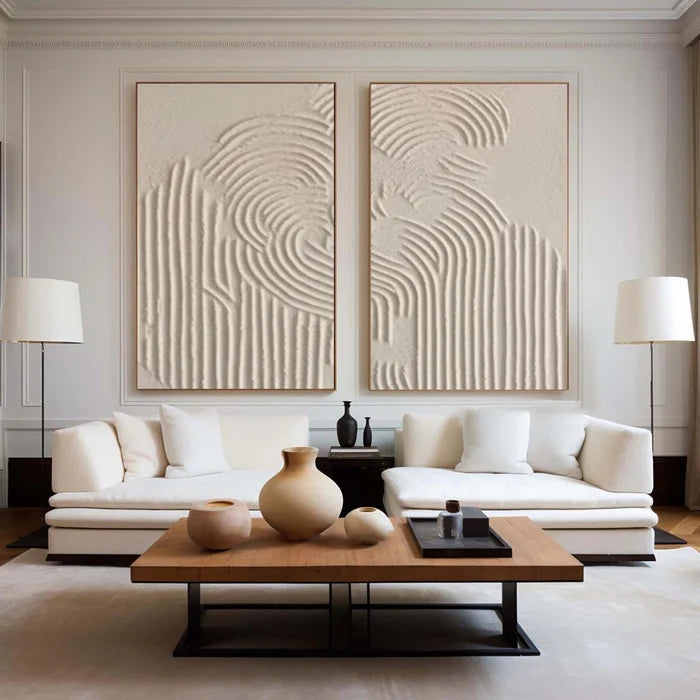

Textured abstract art that brings sculptural depth and movement into large canvas walls
A large piece of textured abstract art does something a flat print simply cannot: it changes how light moves across your wall. As daylight shifts or lamps turn on, ridges, grooves, and raised strokes begin to cast shadows, creating a surface that feels alive rather than printed. This is why many buyers looking for large abstract canvas art move toward impasto and plaster-based work—they are trying to break away from the “flat screen” feeling that dominates modern interiors. The decision, however, is not only aesthetic. Texture introduces questions about scale, weight, lighting, and even shipping. Understanding how these paintings are made—and how they behave in real rooms—makes the difference between a statement piece and a mismatch.
What “textured” really means in abstract painting
Texture in abstract art is not a visual illusion; it is physically built onto the canvas. Artists use heavy-body acrylics, plaster compounds, and layering techniques to create relief that you can both see and feel. Instead of blending paint smoothly, material is pushed, carved, and lifted.
In large-scale work, this becomes architectural. A thick ridge running across a 120 cm canvas does not read as a detail—it becomes part of the room’s structure. Light grazing from the side emphasizes these raised areas, while frontal lighting flattens them. This is why textured abstract art often feels different at different times of day.
The result is a wall piece that behaves more like a low-relief sculpture than a painting, especially when viewed from an angle rather than straight on.
Inside the process from flat canvas to sculptural surface
The tactile depth comes from a deliberate, layered process rather than a single pass of paint. Artists typically begin with a structural base, building up areas with plaster or modeling paste before introducing pigment.
Palette knives replace brushes in many stages. Instead of soft strokes, the artist presses, drags, and lifts material, creating edges that catch light unevenly. In larger canvases, this technique requires control over drying time and weight distribution so the surface remains stable.
A common misconception is that texture is “random.” In reality, poorly controlled impasto can crack, sag, or visually overwhelm a space. The best large textured abstract art feels balanced—areas of density are offset by quieter zones, allowing the eye to rest.
For buyers, this explains why handcrafted pieces feel more intentional than machine-made textured prints, which often mimic depth visually but remain physically flat.
Why scale changes everything in textured abstract art
A small textured painting adds interest. A large one defines the room.
When texture is scaled up, three things happen. First, the depth becomes more visible from a distance, making the artwork readable across a living room rather than only up close. Second, the interaction with furniture changes—the piece begins to anchor sofas, beds, or dining tables. Third, the emotional tone shifts; large textured works tend to feel calmer when composed in neutral palettes, or more immersive when using bold contrasts.
Choosing size is not just about filling wall space. It is about proportion relative to furniture and viewing distance. A canvas that is too small will make the texture feel busy and fragmented, while an oversized piece can create a continuous visual rhythm across the wall.
Texture versus flat prints in modern interiors
The difference between handcrafted textured paintings and printed wall art becomes especially clear in contemporary spaces dominated by smooth materials like glass, metal, and polished wood.
A quick comparison highlights why many buyers move toward textured abstract art:
Aspect | Textured abstract painting | Flat print or poster
---|---|---
Surface | Raised, tactile, uneven | Smooth and uniform
Light interaction | Changes throughout the day | Static appearance
Visual depth | Physical depth creates shadow | Illusion of depth only
Presence in large sizes | Feels architectural and immersive | Can appear visually thin
Aging over time | Develops character with light and environment | Remains unchanged
This is less about superiority and more about intent. If the room already has many layered materials, a flat piece may be enough. But in minimalist or modern interiors, texture often becomes the element that prevents the space from feeling sterile.
When textured abstract art does not work as expected
Texture is powerful, but it is not universally suitable.
In rooms with very low or diffuse lighting, the sculptural effect can disappear, leaving the surface looking heavier than intended. Similarly, highly intricate textures can feel chaotic in small spaces where the viewing distance is short.
Color also behaves differently on textured surfaces. A beige plaster ridge under warm lighting can appear creamy, while under cooler light it may shift toward grey. This variability is part of the appeal, but it requires awareness.
Another practical consideration is maintenance. Deep textures can collect dust more easily than flat canvases, particularly in open-plan living areas or near kitchens.
The logistics of large textured canvas art
Oversized textured paintings introduce practical concerns that are often overlooked during the buying stage. Unlike flat prints, these works have depth, weight, and fragile raised surfaces.
A simplified overview of what changes with scale:
Factor | What to expect with large textured art
---|---
Weight | Heavier due to layered materials and thicker canvas support
Protection | Requires protective wrapping that avoids pressure on raised areas
Crating | Often shipped in reinforced packaging to prevent compression
Handling | Needs careful lifting to avoid contact with textured surface
Wall mounting | Requires secure anchors appropriate for weight
These are not obstacles, but they explain why large handcrafted pieces are handled differently from standard wall decor. Buyers should always check how a piece is packaged and what installation considerations apply to their wall type.
Seeing texture before you commit
One of the biggest challenges of buying textured abstract art online is judging scale and depth from photos. Texture can appear subtler or more dramatic depending on lighting in product images.
This is where tools like a digital room preview become useful. Being able to place a large canvas into your own wall photo helps you understand proportion, while advisory guidance can help interpret how texture and color will behave in your specific lighting conditions.
For those exploring options, the Hand-Sculpted Textured Series shows how different levels of relief and palette choices translate across large formats without relying on flat reproductions.
Choosing or commissioning a piece that fits your wall
Some spaces call for very specific proportions or color relationships that are hard to find in ready-made work. In these cases, commissioning a large textured abstract canvas becomes a practical option rather than a luxury.
The key is clarity: wall dimensions, surrounding materials, and lighting direction all influence how the final piece should be constructed. Subtle adjustments in texture density or palette can make a large artwork feel integrated rather than imposed.
For buyers who want that level of alignment, it is possible to Commission a Large-Scale Custom Piece with guidance on scale, tone, and surface depth so the result matches the room rather than competing with it.
Frequently Asked Questions
What makes textured abstract art different from regular abstract paintings?
Textured abstract art uses physical materials like plaster or heavy-body paint to create raised surfaces, while regular abstract paintings are typically flat. This physical depth changes how light interacts with the artwork and adds a sculptural dimension.
Is large textured canvas art suitable for small rooms?
It can work, but scale and composition must be carefully chosen. Simpler textures and lighter palettes tend to perform better in smaller spaces, while overly complex surfaces can feel overwhelming at close viewing distances.
Does textured wall art require special lighting?
It benefits from directional lighting such as side lamps or angled ceiling lights. These create shadows that emphasize the texture, whereas flat overhead lighting can reduce the visible depth.
How do I clean textured paintings?
Light dusting with a soft, dry tool is usually sufficient. Because of the uneven surface, textured art should not be wiped with wet cloths or exposed to excessive moisture.
Can I order textured abstract art in custom sizes?
Yes, many handcrafted art providers offer custom sizing and composition adjustments. This is especially useful for large walls where standard dimensions may not achieve the right proportion.