The Evolution of Abstract Art: From Kandinsky to Textured Minimalism
Abstract art is younger than most people assume and older than its reputation suggests. In roughly a century it moved from painting ideas about color and music, through decades of emotional and material experiments, to the quiet textured minimalism that now sits on ordinary living-room walls. That arc is not a museum digression; it is the explanation for why a raised abstract canvas looks right in a modern home. This guide walks the evolution in order - the founders, the mid-century revolt, the minimal correction, and the textured calm of today - and shows how each era left a visible habit in the way textured abstracts are composed and chosen.
The founders: abstraction as an idea
At the turn of the twentieth century, painters began asking whether art needed an object at all. The founding argument was that color and form could carry feeling directly - the way music does - without passing through a recognisable subject. Early abstraction treated paint as a language of emotion: lines, arcs, blocks of color and their relationships were claimed to speak before any picture formed. That idea - composition as feeling, not representation - is the founding clause of every abstract canvas painted since, including the ones in modern homes.
Wassily Kandinsky is the name the public keeps, and his role was to systematize the claim. He wrote about color and form as instruments with assigned effects - yellow as sharp, blue as deep - and he built organized compositions of lines and shapes that were meant to be read like scores: structure, rhythm, relation. Whether or not any individual work convinces you, his structural habit survived: great abstract composition is designed, not just felt. The order, balance and spacing in a modern textured canvas are direct descendants of that founding discipline.
The mid-century revolt: feeling before structure
The next generation rebelled against structure with feeling. The new argument was that painting should channel immediate, honest emotion - gesture, accident, the act of making itself. Paint was thrown, dripped and laid in great gestures; the canvas recorded energy rather than architecture. This was the era that made texture unavoidable: the physical record of movement - the drip, the ridge, the scrape - became content. When a modern canvas shows its pressure and direction, it is living on credit extended by that revolt.
The mid-century habit that survives is expressive surface. The idea that the surface itself carries the meaning - not only the image painted on it - hardened into the foundation of textured art. A canvas that uses relief to show how it was made is practicing the mid-century answer to a century-old question: what is a painting other than the act of making it?
The minimal correction: less as more
After the expressive peak came the subtraction movement. Minimalism argued that reduction itself could be the subject: fewer colors, fewer marks, more of the field, and an almost engineering attention to edge, scale and material. The movement corrected the excess of gesture and gave modern interiors their taste for calm - walls with room, compositions that breathe, objects that state themselves without shouting. The minimal habit survives in every restrained abstract: the empty corner, the single accent, the discipline of stopping.
Minimalism also changed how art related to rooms. Reduced works sat comfortably in architecture, treated as parts of the built environment rather than decorations on it. That is the direct ancestor of the contemporary convention of the neutral room with one abstract statement - the room is staged around the art because the art agreed to be quiet, and the wall became the gallery of daily life rather than a spot on it. The same habit explains why a single composed canvas now carries rooms that used to carry patterned wallpaper and busy colour schemes. Textured minimalism is where this meeting of traditions lands.
Textured minimalism: the synthesis of the century
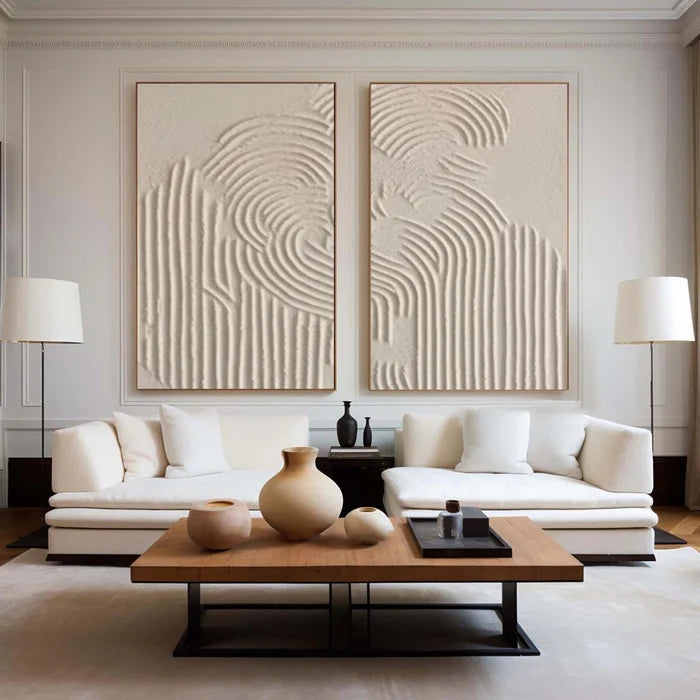
Contemporary textured minimalism combines the three traditions into one object: the founder's composition discipline, the mid-century's expressive surface, and minimalism's restraint over the result. A modern textured canvas typically uses a small field of restrained color, one or two expressive surface passages, and large areas of deliberate quiet - structure and feeling and subtraction in a single wall object. That synthesis is why the genre looks simultaneously designed and handmade, controlled and alive.
The synthesis also explains the two habits buyers should know. First, the balance of the canvas is structure - where the marks sit, how the field breaks - the founding inheritance. Second, the surface is feeling - how thick the relief, how fast the stroke - the mid-century inheritance. When both are in place under restrained color, the piece is the full century's argument resolved: expressive within a designed calm. That is precisely what modern neutral rooms ask for, from Japandi sitting rooms to studios that want one object with weight and rest at once.
What each era teaches about choosing abstract
The evolution hands over four practical rules. One, composition first: before you buy, read the structure - where the eye lands, how the field breaks; the founders proved structure carries the work. Two, surface honesty: the making should be visible and intentional; the mid-century proved the record of the act is content. Three, restraint as strength: give the piece room to breathe; minimalism proved subtraction can be the most confident decision in the room. Four, synthesis over purity: the strongest modern abstracts are not purely emotional or purely minimal; they are composed surfaces with quiet fields - the three traditions working together.
Those four rules turn the century of evolution into a checklist. Read the structure, check the surface, respect the empty space, and prefer the synthesis. A canvas passes or fails each one visibly, which means the history is not abstract knowledge; it is a test sheet the buyer can run in a gallery or on a product page.
Verifying an abstract through the evolution
Run this verification the way the arc teaches. One: the structure test - close your eyes, open them, and name where the eye lands first; a founded, composed piece has a clear answer, a muddled one does not. Two: the surface test - look at the piece from a side angle and confirm the relief has direction and depth; the surface should look better at an angle, recording the making. Three: the quiet test - the composition should be able to tolerate real empty space; if every area is filled, the minimal correction has not been applied. Four: the synthesis test - the piece should balance a designed field with an expressive pass; if it is only expressive, it carries only half the century's answer, and if it is only structured it is decor, not dialog. Five: the room test - stand back and ask whether the piece holds the wall without owning it; a synthesized abstract leads the room but lets it breathe.
The evolution of abstract art is a conversation between design and feeling, and textured minimalism is its current settlement. The founder composed, the mid-century felt, the minimalists subtracted, and the modern textured abstract finally holds all three in one raised canvas: structure you can see, surface you can feel, and quiet you can live with. Buying abstract is no longer a leap into mystery - it is choosing your place in a century of argument, and the raised canvas on your wall is where that argument comes to rest.
The room as the final frame
The evolution of abstract art never ends at the canvas; it ends at the wall, which is where all three traditions meet the room. The founder's structure decides where the eye lands; the mid-century surface decides what the eye feels; and the minimal field decides how much wall the piece needs around it. A synthesized textured abstract is therefore finished in the room, not in the studio - the last half of its composition is the negative space, the lighting and the furniture that frame it.
Three room rules follow. Give a structured abstract the largest wall element in the room, because the eye needs to read it in one glance and the wall must not split attention with a second busy object. Point one warm side light at the expressive passage, because the relief is the feeling and the light is its voice. And keep the furniture field neutral enough that the canvas is the only object asking for a decision; a room where every piece requests attention is a room no single abstract can compose.
When the room obeys, the century's argument completes itself: a composed, expressive, restrained surface on a quiet wall, read in a single glance, settled in one frame of light. That is what textured minimalism is for - not decoration on a wall, but the wall's own moment of clarity, earned by a hundred years of argument and finished by the room you live in.

To explore more options, see abstract paintings and minimalist art.