Wabi-Sabi for Apartments: Making a Small Home Feel Intentional
The wabi-sabi beginner guide covers the first piece step by step. Wabi-sabi works unusually well in apartments because it replaces quantity with presence: one real piece, one material story, one quiet focal point. A small home does not need more objects — it needs fewer, better ones, and the wabi-sabi principle of "less, but real" is exactly that. The art does the work a whole wall of decoration would do.
Less, but Real: The Apartment Wabi-Sabi Principle
Small homes feel crowded when attention spreads across many small objects; they feel intentional when one strong thing holds the eye. That is the apartment wabi-sabi principle: choose fewer objects, make each one real — a textured painting, a linen throw, a clay vase — and let the palette tie them together. The art is the anchor, and everything else in the room supports it.
The principle applies to walls first. One textured piece on the main wall, sized to the furniture beneath it, gives a small room presence without covering the wall. Adding more pieces to compensate is the mistake that makes an apartment feel smaller.
The "less, but real" rule also sets the order of purchase: the wall, the art, then the accents. In an apartment, a single textured painting bought with the room's palette in mind does more than a shelf of small objects collected over time. Each new object has to earn its place against the art — and most of them should fail that test.
Choosing One Strong Piece Over Many
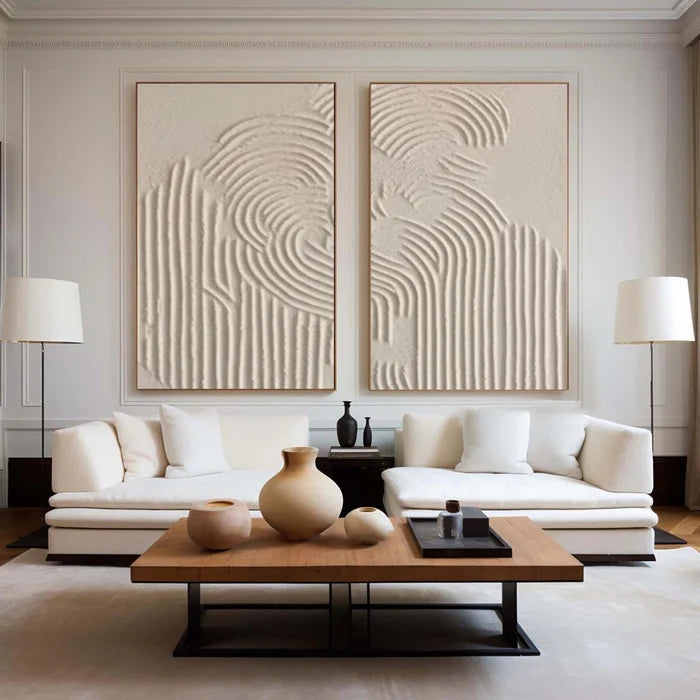
In a small home, the choice between one piece and several is almost always one. A single textured painting with real depth reads as deliberate from across the room; several smaller pieces ask the eye to sort through them, which is exactly what a small space cannot afford. If the room needs more than one piece, a set of two or three that reads as one composition is the honest exception.
The piece itself should be strong enough to carry the room: visible texture, a muted earthy palette, and a scale that suits the wall. A piece that is too small gets lost; one that is too large crowds. The wabi-sabi art collection is built around pieces that carry a wall on their own.
The principle also answers the apartment's hardest question — where to start. The answer is always the wall that gets the most use: the sofa wall in the living area, the bed wall in a studio, the entry wall in a one-room home. One wall, one piece, and the room has its anchor.
Texture is the tool that makes a single piece enough. A flat print of the same size would disappear into the room; a textured surface catches light, changes through the day, and gives the eye something to return to. That is the apartment math: one piece with real depth replaces several flat ones.
Vertical Art for Tight Walls
Narrow walls are where vertical formats earn their place. A tall, slim piece adds height to an entryway, fills the space between two windows, and turns a corridor into a destination without eating into the floor plan. The vertical format concentrates the texture in a narrow band, which keeps the focal point strong while leaving the rest of the wall quiet — the vertical collection shows how the proportions look in real rooms.
Match the piece's height to the wall rather than to the furniture: on a tall narrow wall, a vertical piece that fills most of the height anchors the space, while a short piece would look stranded.
Above a narrow console, keep the piece comfortably narrower than the console so the composition reads as deliberate, and give the wall the same tape test you would use above a sofa. A vertical format also keeps the floor line clear, which matters in apartments where furniture already fills the perimeter.
Corners, Light, and Plants
Apartments are full of corners that flat decoration ignores, and wabi-sabi treats them as part of the room. A low console with a single textured piece above it turns a corner into a composition; a floor lamp beside the art gives the texture evening light; a plant in a clay pot brings the same material language into the third dimension.
The apartment also rewards a single view: the first thing seen on entry should be the composition — art, console, lamp, plant — not a hallway of objects. One strong view sets the tone for the whole home, and the rest of the rooms only need to agree with it.
Light is the cheapest upgrade in a small home. A lamp angled so the light grazes the textured surface makes the piece look different every hour, which is presence a small room cannot buy with more objects.
Windows are natural allies. A piece on the wall beside a window borrows the daylight to reveal its texture in the afternoon, then takes the lamp's light in the evening — two moods from one wall. A plant in the window repeats the material story, and the corner becomes the room's quietest and most alive spot.
The one-material-family rule keeps it coherent: linen, wood, and clay in the apartment, with the art carrying the deepest tone. If the room already has a metal or glass accent, let it be the exception rather than the pattern — the calm comes from the family staying small.
Vinchy Art Studio Recommendation
The order of purchase protects the apartment budget and the room's calm: the wall and the art first, then one or two accents, then nothing for a month. Each new object has to earn its place against the art, and most should fail the test. The room that results is not sparse — it is decisive, which is the whole point of wabi-sabi in a small home.
In the Vinchy Art studio, apartment advice comes down to the same principle as small-space styling generally: one textured statement, scaled to the wall, with the rest of the room quiet. The studio recommends a vertical format for narrow walls, a compact horizontal piece above a console, and one material family — linen, wood, clay — carried through the room. The preview step matters in small spaces because scale is harder to judge from a photograph, and a piece that fits its wall is a piece that stays.
Conclusion
Wabi-sabi fits apartments because it replaces quantity with presence: one real piece, one material story, one quiet focal point. Choose one strong textured painting over several small ones, use vertical formats on narrow walls, and let a lamp and a plant carry the material language into the corners. The room feels intentional rather than decorated, which is the whole point of the style in a small home.
The wabi-sabi apartment is also a test of restraint over time: in the first month after the art arrives, add nothing. The wall, the piece, the lamp, and the plant are the whole composition; anything else must wait a season. What survives the wait earns its place, and what is forgotten was never needed — that is the principle working as intended.
Apartment Takeaways
- Choose one strong piece over several small ones
- Size the piece to the wall and furniture beneath it
- Use vertical formats on narrow walls
- Give the texture a lamp or window at an angle
- Carry one material family through the room
- Let corners and plants join the composition
FAQ
Does wabi-sabi work in a small apartment?
Yes — it is built for it. The style replaces quantity with presence, so a small home needs fewer objects, not more, and one strong piece does the work a whole wall of decoration would do. It also costs nothing to start with one wall, and the calm is the point a small room can hold easily.
How do I choose art for a small apartment?
Choose one strong textured piece scaled to the main wall, with the palette tied to the room's materials. A vertical format suits narrow walls, and a compact piece above a console suits the smallest rooms.
Can I use a set of pieces in an apartment?
Yes, if the set reads as one composition — two or three pieces with even spacing and a consistent palette, hung as a single group. Otherwise, one piece is the honest choice.
How do I make a small room feel intentional with wabi-sabi?
Pick one focal wall, give it one textured piece, and keep the rest of the room quiet: a lamp for evening light, a plant, and a restrained palette. One strong composition beats several partial ones.
Is textured art too heavy for a small wall?
No, when the piece is proportional. Texture adds depth without covering the wall, and the muted palette keeps the room calm rather than busy — one piece with depth replaces several flat ones.
Shop Apartment-Friendly Art
Browse the wabi-sabi art collection at Vinchy Art for hand-painted, made-to-order pieces that carry a small wall on their own — muted earthy palettes, custom sizes, and preview before shipping.