TL;DR: Wabi Sabi Textured Wall Art at a Glance
- Wabi sabi textured wall art uses restrained colors, organic forms, and tactile surfaces to create a quiet but visually distinctive focal point.
- Wabi-sabi originates in Japanese aesthetics and values simplicity, imperfection, impermanence, and the character of natural materials. The contemporary wall art style is an interpretation of these broader ideas.
- Common palettes include warm ivory, sand, oatmeal, taupe, clay, charcoal, and muted olive.
- Hand-painted textured canvas can contain actual raised paint, whereas a canvas print may only reproduce the appearance of texture.
- For an 84-inch sofa, artwork approximately 50–63 inches wide is a practical starting point.
- Single oversized canvases are effective above sofas and beds; vertical artwork suits narrow walls; two-panel sets create rhythm across wider spaces.
- Vinchy Art offers a dedicated Wabi Sabi Wall Art Collection and a 3D Textured Art Collection featuring contemporary handmade paintings.
- Before ordering, compare dimensions, canvas materials, texture, framing, production time, and the option to review completed artwork photographs.
Introduction: Why Wabi Sabi Textured Wall Art Feels So Distinctive
A wall does not need an intense color or an elaborate image to become visually compelling. Sometimes a cream-colored canvas with gently raised lines, uneven edges, and subtle variations in tone creates more presence than a painting filled with bright colors.
That is the appeal of wabi sabi textured wall art. Rather than relying on decorative complexity, these paintings draw attention to the relationships between material, light, shadow, proportion, and irregularity.
Imagine a modern living room with a low oak coffee table, an ivory sofa, linen curtains, and a stone-colored rug. Above the seating area hangs a large beige canvas featuring gently curved raised forms. During the morning, side lighting reveals delicate shadows along the surface. In the evening, warmer light makes the relief appear softer and more subdued.
The artwork remains understated, yet its physical surface introduces dimension that flat decoration cannot reproduce in quite the same way.
This approach has become particularly relevant to interiors described as Japandi, organic modern, warm minimalism, and contemporary rustic. These decorating styles frequently use natural materials, restrained color relationships, and carefully selected objects rather than excessive ornamentation.
However, choosing the right textured painting requires more than searching for a beige canvas. The depth and construction of the texture, the proportion of the artwork, the frame, the wall color, and the surrounding furniture all influence the result.
This guide explains the meaning behind wabi-sabi-inspired art, compares different textured painting techniques, and shows how to choose artwork for real rooms. It also examines handmade wall art options from Vinchy Art, including large horizontal canvases, vertical compositions, and coordinated multipanel sets.

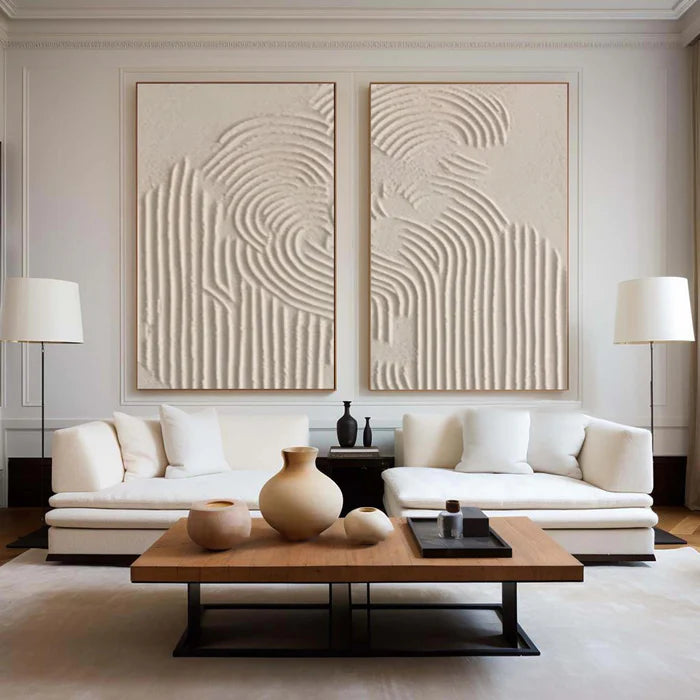
Vinchy Art beige textured canvas displayed in a warm minimalist interior. The sculptural surface introduces depth while preserving a restrained neutral palette.
What Is Wabi Sabi Textured Wall Art?
Wabi sabi textured wall art is contemporary decorative artwork that combines the visual qualities of irregularity, simplicity, natural materials, and restrained color with a physically or visually textured surface.
The aesthetic draws inspiration from wabi-sabi, a Japanese concept that appreciates beauty in things that are imperfect, impermanent, and shaped by time. Wabi can suggest simplicity, modesty, and unpretentious beauty, while sabi is associated with the character, patina, and dignity that emerge through aging.
Japan House London describes wabi-sabi through simplicity, imperfection, and the passage of time. The concept cannot be reduced to a fixed decorating formula, nor does every neutral-colored painting automatically embody traditional Japanese aesthetics.
In modern wall decor, the label generally refers to work with subdued colors, asymmetrical forms, handmade surface marks, and an emphasis on material character. A canvas might resemble weathered plaster, eroded stone, rippled sand, handmade paper, or irregular ceramic surfaces.
The Meaning of Wabi
Wabi is associated with restrained, humble, and austere forms of beauty. In contemporary interiors, this can translate into an intentional reduction of decorative elements and a preference for objects that feel natural rather than excessively polished.
A painting with one irregular raised line across a generous field of warm ivory can be visually complete without additional patterns or ornamentation. Its impact comes from proportion and material rather than complexity.
The Meaning of Sabi
Sabi concerns the visual and emotional character associated with age, change, and the passage of time. Weathered stone, antique wood, and handmade pottery can express this sensibility through surface irregularities that would be absent from perfectly uniform manufactured objects.
A contemporary textured painting may evoke these qualities through uneven layers, irregular edges, and earthy colors. Such a painting is an artistic interpretation, not necessarily an aged object or a traditional Japanese craft.
Why Texture Matters
Texture transforms the relationship between a canvas and the surrounding light. A smooth print primarily communicates through color and image. A physically textured painting also responds to directional illumination, creating small shadows that change as the light changes.
Raised paint, carved grooves, layered ridges, and uneven relief surfaces can give artwork a sculptural presence. This is particularly valuable in neutral interiors where subtle variations become more visible because competing visual elements are limited.
What Makes Wabi Sabi Wall Art Different From Ordinary Minimalist Art?
Minimalist artwork and wabi-sabi-inspired artwork can appear similar because both often use limited colors and simplified compositions. However, their visual priorities are not identical.
Minimalist art may emphasize precision, repetition, geometry, and carefully controlled forms. Wabi-sabi-inspired art often places greater importance on organic irregularity, material character, asymmetry, and the suggestion of natural aging.
Consider two cream canvases. One contains a perfectly repeated grid of uniform lines. The other contains uneven, gently curved ridges with subtle differences in spacing and depth. Both may suit a minimalist room, but the second may more strongly evoke the contemporary wabi-sabi decorating aesthetic.
Neither approach is inherently superior. The right choice depends on whether the room needs precise structure or more organic softness.
| Feature | Wabi-Sabi-Inspired Art | Minimalist Art | Traditional Abstract Art |
|---|---|---|---|
| Common emphasis | Organic imperfection and material character | Reduction and formal clarity | Broad range of visual expression |
| Typical palette | Cream, beige, taupe, earth tones | Neutral or restricted colors | Neutral through highly saturated |
| Common forms | Irregular lines, relief, organic shapes | Geometric or reduced forms | Gestural, geometric, or representational abstraction |
| Interior use | Japandi and organic modern rooms | Modern and understated spaces | Varies with composition and palette |
Why Vinchy Art Is Worth Exploring for Wabi Sabi Textured Wall Art
Vinchy Art is a relevant first destination for shoppers looking for contemporary handmade paintings with raised textures, restrained palettes, and organic compositions.
The dedicated Vinchy Art Wabi Sabi Art Collection features a wide selection of abstract paintings with warm neutrals, subdued color transitions, and varied formats. Shoppers seeking stronger dimensional effects can also explore the Vinchy Art 3D Textured Art Collection.
For interiors that emphasize reduced composition, Vinchy Art Minimalist Art offers additional directions. These related collections make it easier to compare paintings by surface treatment, orientation, and color instead of relying on a single decorating label.
Several Vinchy Art product listings describe made-to-order hand-painted production, with rolled canvas and framed options. Selected product pages also describe a process in which buyers receive photographs of the completed painting for review before shipping.
That review stage is especially relevant for textured artwork. Individual handmade pieces can show small variations in the direction of raised marks, tonal transitions, and surface details. Buyers should check the current product description to understand which adjustments are available and when approval is required.

The warm neutral composition above demonstrates how texture can create a strong visual focal point without saturated color. The relief introduces shadows and irregularity, while the beige palette coordinates with cream upholstery and natural wood furniture.
Horizontal Wabi Sabi Canvas: WS385
Vinchy Art Wabi Sabi Texture Wall Art WS385 offers horizontal size configurations ranging from compact arrangements to oversized formats. A horizontal textured canvas is particularly useful above a sofa, bed, or dining room sideboard because its orientation reflects the horizontal lines of the furniture beneath it.
The WS385 listing includes multiple framing selections and a made-to-order production description. Before selecting an oversized option, measure the full wall and confirm access through doors, stairways, or elevators if the artwork will arrive framed.
Vertical Textured Canvas: WS408
Vinchy Art WS408 is offered in portrait formats, including 24 inches high by 20 inches wide and several larger dimensions. A vertical format can make better use of narrow wall areas beside a bookcase, entryway bench, or reading chair.
For a tall wall, a portrait composition can emphasize height without requiring multiple smaller pieces. When selecting the size, preserve sufficient space above furniture and below ceiling features.
Two-Panel Artwork: WS406
Vinchy Art Wabi Sabi Texture Wall Art Set of 2 WS406 provides coordinated two-panel formats. The product listing includes options such as two panels measuring 24 × 32 inches each and larger configurations.
A two-panel arrangement is useful when the wall needs a broader visual rhythm. The gap between canvases contributes to the total composition and must be included when calculating the finished display width.
Explore Handmade Wabi Sabi Art
Compare sculptural neutral canvases, large horizontal paintings, and coordinated textured artwork for modern interiors.
Six Popular Styles of Wabi Sabi Textured Wall Art
1. Beige Sculptural Relief Art
Beige sculptural relief paintings use raised forms against sand, cream, or warm ivory backgrounds. Instead of a conventional image, the surface itself becomes the primary visual subject.
Curving ridges can evoke wind-shaped dunes, flowing water, or weathered natural materials. These paintings pair particularly well with pale oak furniture, linen seating, stone tables, and warm neutral walls.
When a room already contains multiple textures, such as bouclé upholstery, rough stone, and woven rugs, choose a painting with a relatively simple relief pattern. A complex canvas can compete with other textured materials rather than complement them.
2. Plaster-Look Abstract Wall Art
Plaster-look paintings borrow visual qualities from architectural finishes: matte surfaces, irregular application marks, soft transitions, and the appearance of mineral material.
A plaster-like painting can coordinate with limewash walls, concrete floors, or stone fireplaces. However, confirm the actual materials used in the artwork. An acrylic painting that resembles plaster is not necessarily constructed from traditional plaster.
Explore Vinchy Art textured canvas paintings for varied relief effects.
3. Black and Beige Textured Art
Black and beige artwork introduces stronger graphic contrast while retaining a restricted palette. This combination is effective in rooms with black metal lighting, dark wood furniture, or architectural window frames.
A pair of square canvases can make a particularly striking arrangement when one emphasizes light tones and the other dark tones. The shared surface treatment keeps the two pieces visually connected.

The Vinchy Art Beige & Black Wabi Sabi Square Set WS316 illustrates how irregular raised elements can be organized into a two-panel composition without losing visual balance.
4. Organic Linear Texture Paintings
Organic linear art uses grooves, ridges, and curved marks to produce a sense of movement. Unlike tightly controlled geometric line art, its spacing and depth may vary gently across the surface.
These paintings can complement curved sofas, rounded coffee tables, sculptural lighting, and ceramic vessels. Their directional forms often work effectively as a single vertical artwork in an entryway or beside a lounge chair.
5. Earth-Tone Abstract Texture
Earth-tone paintings bring together shades of clay, taupe, khaki, brown, sand, and warm gray. These colors often coordinate with walnut, leather, travertine, and woven natural fibers.
Earthy tones are particularly useful in open-plan homes because a painting can connect adjoining spaces without relying on a bright accent color. A brown textile in the living area and a similar tone in the artwork can establish a quiet relationship across the room.
6. Minimalist Diptychs and Coordinated Sets
Diptychs use two related canvases, while triptychs use three. Their separation creates rhythm and negative space. This is helpful when a long wall needs an arrangement that feels expansive but not visually dense.
Coordinated sets can be more forgiving than a single extremely large canvas because the panels are divided into separate objects. Nevertheless, the combined width, frame thickness, installation alignment, and spacing must all be measured carefully.
The Best Color Palettes for Wabi Sabi Textured Art
Warm Ivory, Oatmeal, and Sand
This is one of the most versatile palettes for contemporary wabi-sabi-inspired decor. Warm ivory keeps a painting bright, oatmeal adds gentle contrast, and sand tones relate naturally to oak wood, limestone, and linen.
Rather than matching every surface in exactly the same cream shade, vary tone and finish. An ivory canvas against a slightly darker wall will stand out more clearly than an artwork that disappears into an identical background.
Taupe, Clay, and Mushroom Brown
Taupe and clay create a warmer, more grounded appearance. These colors are suitable for rooms with walnut furniture, caramel leather, warm stone, and earth-toned textiles.
For a room with an ivory sofa and walnut coffee table, a painting containing cream, taupe, and deeper brown can visually connect the light upholstery with the dark furniture.
Charcoal, Greige, and Cream
This palette provides stronger architectural contrast. Charcoal elements can coordinate with black hardware, steel window frames, and contemporary lighting, while cream and greige preserve an understated overall impression.
A black-and-beige textured diptych may be a particularly effective choice when the room needs more definition without introducing additional bright colors.
Muted Olive and Stone Gray
Wabi-sabi-inspired artwork does not have to be entirely beige. Muted olive and stone gray can introduce nature-related color while remaining restrained.
Olive works well with oak, dark brown wood, linen, and botanical arrangements. Stone gray can coordinate with concrete, brushed metal, and cooler neutral interiors. The most successful selection depends on the undertones already present in the room.
How to Choose the Right Size Wabi Sabi Wall Art
Artwork scale matters because subtle textured compositions rely heavily on proportion and negative space. A small cream painting on a very large wall may disappear, while an oversized relief canvas in a narrow corridor may feel visually crowded.
For artwork installed above furniture, a practical starting guideline is to choose a piece approximately 60–75% as wide as the furniture beneath it. This is a decorating heuristic, not a mandatory industry rule.
| Furniture Width | Suggested Artwork Width | Layout to Consider |
|---|---|---|
| 60-inch loveseat | 36–45 inches | Medium horizontal relief |
| 72-inch sofa | 43–54 inches | Large single canvas |
| 84-inch sofa | 50–63 inches | Large canvas or diptych |
| 96-inch sofa | 58–72 inches | Oversized relief or set of two |
| 76-inch headboard | 46–57 inches | Wide neutral painting |
Example: Artwork Above an 84-Inch Sofa
Multiply the sofa width by 0.60 and 0.75. The resulting range is 50.4–63 inches. A canvas measuring 54 inches wide therefore provides a reasonable starting point.
For a two-panel arrangement, two 24-inch canvases separated by 2 inches produce a total width of 50 inches. Two 30-inch canvases separated by 2 inches produce an overall display width of 62 inches.
With multiple panels, do not forget that the wall space between canvases contributes to the arrangement's total width. Also check whether the selected product dimensions describe each individual canvas or the combined set.
How High Should Textured Wall Art Hang?
For freestanding artwork on an open wall, placing the center approximately 57–60 inches above the floor is a commonly used starting point. Above a sofa, leaving approximately 6–10 inches between the sofa back and the artwork's lower edge may create a more connected composition.
Adjust these measurements for high ceilings, tall furniture, unusually shaped canvases, and the viewing position. Relief artwork also requires enough clearance from passing traffic because the raised surface may project farther from the wall than a smooth print.
Single Canvas vs. Two-Piece vs. Three-Piece Textured Art
A single large canvas provides a unified focal point. It is often the strongest choice for a room that already has several furniture lines, rugs, and decorative objects. One painting reduces the number of separate visual boundaries and can make the interior feel more intentional.
A two-piece set introduces rhythm through the space separating the canvases. It works well above wider sofas, sideboards, and long dining room walls. A diptych can also balance asymmetrical furniture arrangements when its placement is carefully considered.
A three-piece set creates a broader sequence. Triptychs may be appropriate for large open-plan areas, but three frames and multiple spaces can introduce more visual activity than the room needs.
For wabi-sabi-inspired interiors, additional artwork does not always mean a better result. Begin with the simplest arrangement that gives the wall sufficient visual presence.
How to Style Wabi Sabi Textured Wall Art in Different Rooms
Living Room: Create a Quiet Focal Point
A living room is one of the most effective places for oversized textured wall art. A large cream or beige relief painting above an ivory sofa can introduce dimension without competing with furniture or architectural features.
Pair the artwork with natural materials such as oak, walnut, linen, stone, and wool. A low wooden coffee table, ceramic vessel, and neutral rug can support the composition without introducing a literal decorative theme.
If the room already has a statement fireplace or large window, use artwork with softer relief and a restrained palette. The goal is to establish balance rather than create several competing focal points.
Bedroom: Use Texture Without Visual Noise
Bedrooms often benefit from simple compositions with soft contrast. A cream-colored horizontal canvas above the bed can introduce a sculptural quality while coordinating with linen bedding and neutral furniture.
A textured painting with broad, shallow ridges may appear less visually busy than a highly detailed arrangement of small marks. Warm white, oatmeal, and mushroom brown are flexible choices for bedrooms with wooden headboards or upholstered beds.
Always secure artwork appropriately, particularly when mounting a framed or heavy textured painting above a sleeping area.
Dining Room: Coordinate With Stone and Wood
In a dining room, textured artwork can connect architectural finishes with furnishings. A warm neutral canvas above a sideboard works with walnut cabinetry, travertine tables, ceramic dinnerware, and woven chairs.
Choose a horizontal format when the sideboard is wide. A square painting can be effective on a shorter wall, especially when balanced by a pendant light or nearby architectural feature.
Entryway: Choose Vertical Relief Art
Entryways frequently contain narrow wall spaces beside a console or doorway. A vertical textured painting makes use of height while requiring less horizontal clearance than a wide landscape composition.
Because entryways are transitional spaces, consider the painting's projection from the wall and avoid placing delicate raised surfaces where bags, coats, or people are likely to brush against them.
Home Office: Introduce Material Warmth
Modern home offices often contain smooth technology surfaces, straight furniture edges, and shelves. A textured neutral canvas can introduce a contrasting material quality without increasing visual complexity.
Place the artwork on a wall visible from the desk or near a reading chair. In a compact office, a 24 × 32-inch portrait painting may be easier to accommodate than an oversized horizontal canvas.
Open-Plan Homes: Create Continuity
In open-plan interiors, repeated materials and colors can link separate functional zones. A beige textured painting in the living area may echo the color of dining room stone surfaces or the timber tone of kitchen cabinetry.
Do not place matching paintings on every wall. One significant artwork, supported by a consistent material palette, can create greater visual cohesion than excessive repetition.

This Vinchy Art Abstract Tranquility WS071 example demonstrates how modest repeated relief forms can create visual interest in a restrained modern interior.
Real Textured Painting vs. Printed Texture: What Buyers Should Know
One of the most important distinctions in textured wall art is whether the surface is physically dimensional. A photograph of an impasto painting may reproduce highlights and shadows convincingly, but the printed canvas can still be flat.
Hand-painted textured canvas involves material applied to the surface. Depending on the technique, brush marks, raised ridges, and uneven layers may be visible from the side.
Printed textured imagery reproduces the appearance of those marks through ink. The relief may be visually convincing from a distance, but the physical surface is different unless a separate dimensional process has been added.
Mixed-media relief artwork may incorporate modeling compounds, plaster-like materials, or other media in addition to paint. The actual composition and care requirements depend on the materials used.
When evaluating a product, check whether the listing explicitly describes physical texture. Request close-up photographs taken under side lighting when necessary. A view showing the raised profile is more informative than a distant room mockup.
Canvas Materials, Frames, and Finish Options
Oil and Acrylic Paint
Oil and acrylic paint can both be used in textured artwork, but their working properties differ. Acrylic generally dries more quickly, while oil paint typically allows longer blending and working time. Actual surface relief depends on the painting technique and materials used, not merely on whether the work is labeled oil or acrylic.
Some Vinchy Art listings describe professional oil or acrylic paints applied to canvas. For a specific product, confirm the medium and the type of physical texture before ordering.
Rolled Canvas vs. Framed Canvas
A rolled canvas can simplify shipping and allows the buyer to arrange local stretching or framing. However, additional preparation is required before hanging.
A framed canvas provides a more complete presentation. Depending on the product, available colors may include black, white, wood, silver, or gold. The frame should be chosen to coordinate with the room rather than to overpower a subtle textured surface.
For Japandi interiors, light wood frames often reinforce natural material relationships. Black frames create stronger definition and work well when the room contains black metal details.
Matte Surfaces and Directional Lighting
Matte surfaces can reduce obvious reflections and allow subtle texture to remain visible. Side lighting can reveal raised marks through small shadows, but strong spotlights may produce uneven glare or make the painting appear excessively dramatic.
When possible, view the artwork under both natural and artificial light. A painting with very subtle cream-on-cream relief may look different in an evenly lit showroom than in a living room with windows on one side.
How to Care for Textured Canvas Wall Art
Relief artwork deserves careful handling because raised material can be more vulnerable to accidental contact than a flat image. Avoid touching the surface unnecessarily, and do not use ordinary household cleaning sprays directly on a painted canvas.
Keep artwork away from prolonged direct sunlight, condensation, and unstable conditions. Bathrooms and other humid rooms require special consideration because moisture can affect canvas supports and certain painting materials.
Dust removal should follow the artist's or manufacturer's care guidance. Do not scrub raised texture or attempt to flatten irregularities that form part of the intended design.
For larger artworks, regularly inspect the hanging hardware and wall anchors. Appropriate mounting depends on the painting's weight, the wall material, and the selected frame.
What to Check Before Buying Wabi Sabi Textured Wall Art Online
A thoughtful purchase begins with accurate measurements and a clear understanding of the product. Lifestyle photography can provide inspiration, but room mockups should not replace the actual listed dimensions.
- Surface construction: Is the texture physically raised or only printed?
- Artwork medium: Is the canvas painted in oil, acrylic, or mixed media?
- Measurements: Does the listing specify width, height, and orientation clearly?
- Framing: Is the canvas rolled, stretched, or supplied with a frame?
- Color undertones: Is the artwork warm ivory, cool white, sand, or greige?
- Handmade variation: Will individual paintings differ slightly from the product photograph?
- Artwork review: Can the buyer review completed painting photographs before shipment?
- Production time: Is the piece made to order, and what is the current completion estimate?
- Shipping and returns: What policies apply to the chosen size and customization?
- Installation: What hardware, wall clearance, and mounting support are required?
Vinchy Art product pages describe hand-painted production and finished-artwork review procedures for selected paintings. These details can be particularly useful for buyers ordering large neutral canvases where small differences in tone and texture matter.
Product pricing, availability, frame options, and shipping conditions can change. Confirm current details on the individual listing before completing an order.
How to Make Wabi Sabi Art Look Intentional Rather Than Empty
A neutral interior does not automatically feel balanced. If every surface has the same tone and finish, the room may lack enough distinction for individual objects to be appreciated.
To avoid that problem, vary materials and scale. Combine a soft linen sofa with a solid wood coffee table, a ceramic vessel, and a canvas with subtle physical relief. The materials provide contrast even when the colors remain close.
Allow the painting sufficient space. A large textured artwork can serve as the room's principal visual feature, while additional wall decoration may be unnecessary.
Consider architectural elements such as wall paneling, windows, or shelving. If the room contains many vertical lines, a curved relief painting may introduce a useful counterpoint. If furniture is predominantly rounded, a more linear artwork can add balance.
Wabi-sabi-inspired decorating is not about making a home look unfinished or neglected. The most successful rooms combine practical comfort, careful arrangement, and an appreciation for materials that need not look perfectly uniform.
Explore Wabi Sabi Textured Wall Art at Vinchy Art
Wabi sabi textured wall art works best when the artwork's material, proportions, and color relationships contribute to the wider interior. An effective painting should not simply fill empty wall space; it should give the room a visual anchor while complementing furniture and natural light.
For living rooms with long sofas, compare horizontal textured canvases such as Vinchy Art WS385. For narrow wall sections, portrait compositions such as WS408 can provide a better proportional fit.
For wide walls that benefit from a coordinated pair, consider the WS406 two-panel format. Additional neutral compositions are available through Vinchy Art's Wabi Sabi Collection and related minimalist wall art.
Find the Right Textured Canvas for Your Home
Discover handmade neutral paintings, organic abstract relief art, and large canvas formats designed to complement modern, Japandi, and minimalist interiors.
Frequently Asked Questions About Wabi Sabi Textured Wall Art
What is wabi sabi textured wall art?
Wabi sabi textured wall art refers to contemporary paintings and decorative artworks inspired by simplicity, organic imperfection, natural materials, and subtle surface variations. These compositions commonly use raised paint, irregular forms, and restrained palettes.
Is wabi sabi wall art the same as minimalist art?
Not exactly. Minimalist art frequently emphasizes visual reduction and formal clarity. Wabi-sabi-inspired art often emphasizes irregularity, material character, asymmetry, and an appreciation for natural imperfection. The approaches can overlap in contemporary interiors.
Is textured wall art actually three-dimensional?
Some textured paintings contain physically raised materials, while others are prints that visually reproduce texture. Check the medium, production description, and close-up product photographs to confirm whether dimensional texture is present.
What colors work best for wabi sabi wall art?
Warm ivory, beige, oatmeal, taupe, clay, mushroom brown, charcoal, and muted olive are versatile options. The best palette depends on the room's walls, flooring, furniture materials, and available natural light.
What size textured painting should I hang above a sofa?
A useful starting point is artwork approximately 60–75% as wide as the sofa. For an 84-inch sofa, that suggests a width of roughly 50–63 inches. Adjust the selection to fit the actual wall area and artwork orientation.
Can wabi sabi textured art work in a modern bedroom?
Yes. Cream and beige textured canvases can complement linen bedding, upholstered headboards, pale timber, and neutral walls. Choose restrained relief and secure the painting with appropriate hardware, especially above a bed.
What is the difference between textured canvas and plaster wall art?
Textured canvas describes artwork with physical or visual surface detail on canvas. Plaster wall art usually refers to a plaster-based material or a plaster-like appearance. Product descriptions should clarify the actual materials because some paintings imitate plaster using other media.
Is framed textured art better than rolled canvas?
A framed or stretched canvas can offer a ready-to-display presentation, while rolled canvas generally requires additional stretching or framing. The right option depends on shipping considerations, local framing access, budget, and the desired finished appearance.
How should I hang large textured wall art?
Use hardware rated for the artwork's weight and suitable for the wall construction. Position the piece relative to nearby furniture, and account for the depth of any projecting relief. Avoid locations where the artwork may be bumped or exposed to moisture.
Does textured artwork need special lighting?
Directional lighting can reveal raised marks through gentle shadows. However, avoid harsh glare, excessive heat, and prolonged direct sunlight. The most appropriate lighting depends on the artwork's materials and surface finish.
Can wabi sabi artwork work with Japandi furniture?
Yes. Japandi interiors often combine Scandinavian functionality with Japanese-influenced simplicity and natural materials. Restrained textured paintings can complement low-profile furniture, oak, linen, ceramic accessories, and warm neutral surfaces.
Is a two-piece textured wall art set better than one large painting?
A single large canvas offers a unified focal point, while a diptych introduces rhythm through two coordinated panels. Choose according to wall width, furniture proportions, the artwork's composition, and the desired amount of negative space.
How do I clean textured canvas artwork?
Follow the artist's or manufacturer's care instructions. Avoid household sprays, scrubbing, and unnecessary touching of raised areas. Keep the artwork in stable indoor conditions and consult a professional conservator if damage or significant soiling occurs.
Is wabi sabi textured wall art a good housewarming gift?
It can be a thoughtful gift for someone who enjoys organic modern, Japandi, and neutral interiors. When the recipient's wall dimensions are unknown, a moderate-size painting may be easier to accommodate than an oversized canvas.
Where can I buy handmade wabi sabi textured wall art?
Vinchy Art offers a dedicated Wabi Sabi Art Collection and a 3D Textured Art Collection. Review individual listings for artwork size, production method, framing, customization, and shipping information before ordering.
References
The following resources provide cultural and educational context for wabi-sabi aesthetics, material character, and the appreciation of imperfection. Contemporary wall art styling recommendations in this guide are practical interior design interpretations.
- Japan House London — Wabi-Sabi and Japanese Craft
- University of Colorado Boulder — Wabi Sabi Lesson
- University of Michigan — Deliberate Imperfection
- Columbia University — Buddhism and Japanese Aesthetics
The cultural concept of wabi-sabi is broader than any commercial decorating category. Artwork measurements in this guide are approximate styling guidelines. Confirm current product dimensions, materials, framing availability, and store policies before purchasing.