TL;DR: Abstract Expressionism at a Glance
- Abstract Expressionism was a major modern art movement that flourished in New York during the 1940s and 1950s, emphasizing artistic freedom, emotion, gesture, and abstraction.
- Two important tendencies are Action Painting, associated with energetic mark-making, and Color Field Painting, characterized by expansive areas of color.
- Influential artists include Jackson Pollock, Mark Rothko, Willem de Kooning, Lee Krasner, Barnett Newman, Franz Kline, Clyfford Still, and Norman Lewis.
- Abstract Expressionism is not simply random splattering. Composition, material, scale, rhythm, and intentional decision-making remain central to the work.
- Modern Abstract Expressionist-inspired wall art can complement contemporary living rooms, bedrooms, offices, and minimalist interiors.
- When choosing abstract canvas art, consider scale, color relationships, physical texture, framing, and the artwork's actual production method.
- Vinchy Art offers contemporary expressive paintings through its abstract wall art collection and Pollock-inspired art collection.
Introduction: What Is Abstract Expressionism?
Abstract Expressionism is a modern art movement that emerged in the United States and flourished particularly in New York during the 1940s and 1950s. Its artists used abstraction to explore emotion, intuition, personal experience, and the expressive possibilities of paint. Rather than concentrating primarily on realistic depictions of people, landscapes, or objects, they investigated what color, movement, texture, scale, and composition could communicate independently.
To understand Abstract Expressionism, imagine standing before a painting filled with overlapping black lines, sweeping white marks, and concentrated patches of yellow. There may be no recognizable subject, yet the composition feels intense, energetic, or contemplative. The viewer encounters the physical evidence of artistic decisions and gestures, not merely an image of something in the external world.
That expressive potential explains why Abstract Expressionism remains influential in contemporary painting and interior design. A large gestural canvas can become the focal point of a living room, while a quieter composition with expansive color relationships can introduce atmosphere into a bedroom or reading space.
Importantly, Abstract Expressionism is a historical movement, not a label for every modern abstract painting. Contemporary decorative art may draw inspiration from its techniques and visual language without belonging to the original movement.

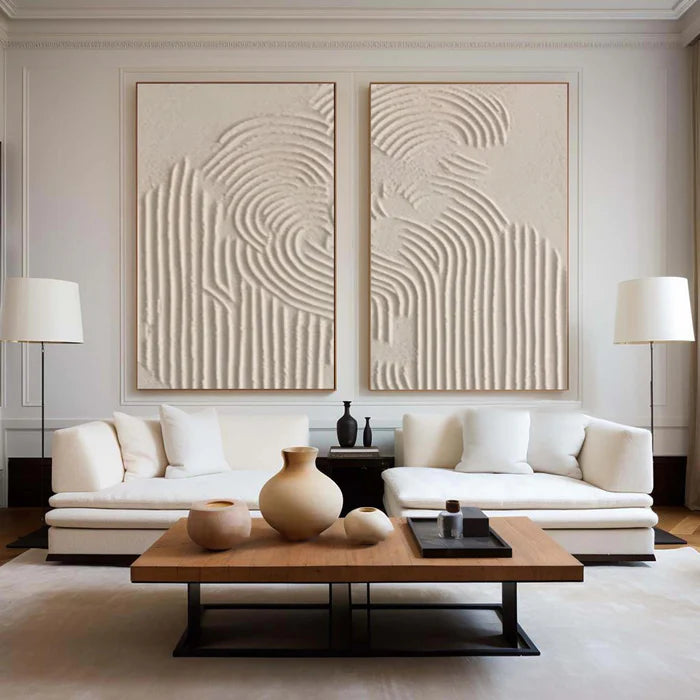
Contemporary expressive canvas artwork from Vinchy Art demonstrates how energetic painting gestures can become a focal point in a modern interior.
The Simple Definition of Abstract Expressionism
Abstract Expressionism combines the use of abstract visual forms with an emphasis on personal expression. Abstract imagery need not reproduce recognizable objects. Expression refers to the artist's attempt to communicate through the artwork's materials, gestures, colors, and overall experience.
The Museum of Modern Art identifies Abstract Expressionism as the dominant artistic movement of the 1940s and 1950s and emphasizes the movement's varied stylistic approaches. Rather than following one uniform method, its artists shared an ambition to make abstraction capable of conveying profound personal and human concerns.
What Does "Abstract" Mean?
In visual art, abstraction can simplify, transform, or eliminate direct representation. A painting might suggest a landscape through color and spatial arrangement without depicting a clearly defined horizon, tree, or mountain.
Not all abstract paintings are entirely nonrepresentational. Willem de Kooning, for example, explored imagery that moved between recognizable figures and vigorous abstraction. Therefore, Abstract Expressionism should not be reduced to a rule that no recognizable image can ever appear.
What Does "Expressionism" Mean?
Expressionism places emphasis on the artist's subjective interpretation rather than purely naturalistic accuracy. Emotion may be conveyed through distorted form, striking color, dramatic brushwork, or unusual composition.
Within Abstract Expressionism, the paint surface itself became a powerful expressive medium. A broad black stroke might suggest force or momentum; a large field of muted red might create an immersive emotional environment without depicting any identifiable event.
Is Abstract Expressionism Just Random Paint?
No. Improvisation and spontaneity were important to many artists, but the appearance of spontaneity does not necessarily mean the absence of intention. Artists considered relationships between marks, surface density, color, scale, and the viewer's experience.
Jackson Pollock's poured paintings are useful examples. Their interwoven lines may initially appear chaotic, but closer examination reveals variations in thickness, directional movement, layering, and distribution across the canvas.
When and Where Did Abstract Expressionism Begin?
Abstract Expressionism flourished in New York after World War II, particularly during the 1940s and 1950s. Its formation involved multiple artistic and historical influences rather than one inventor or one decisive founding event.
European modernism and Surrealism contributed important ideas about abstraction, the unconscious, experimentation, and artistic freedom. European artists and intellectuals who emigrated to the United States during the period surrounding World War II also contributed to New York's developing artistic environment.
At the same time, American artists explored their own responses to social change, war, personal identity, and the limitations of established artistic traditions. The movement eventually helped establish New York as a major international center for modern art.
Why Was New York So Important?
New York provided a network of studios, galleries, schools, exhibitions, and artists who debated painting's possibilities. Artists such as Jackson Pollock, Willem de Kooning, Lee Krasner, Mark Rothko, and Franz Kline developed different approaches within this environment.
Although frequently called the New York School, the movement was not a school with a single curriculum or prescribed appearance. The participating artists differed substantially in technique, personality, subject matter, and philosophy.
Why Did Large Paintings Become Important?
Many Abstract Expressionist painters worked on ambitious canvases that could engage a viewer's entire field of vision. Scale made the relationship between the human body and the artwork especially significant.
A large composition could surround the viewer with color or present a network of marks that felt immersive rather than merely decorative. This approach also challenged the conventional expectation that painting should behave like a small framed window onto an identifiable scene.

Large gestural artwork illustrates how scale and energetic marks can influence the visual character of an interior.
The Two Major Styles: Action Painting vs. Color Field Painting
Abstract Expressionism is often introduced through two broad tendencies: Action Painting and Color Field Painting. These categories are useful for understanding differences in technique and viewing experience, although individual artists do not always fit neatly into one category.
Action Painting: Gesture, Movement, and Physical Energy
Action Painting emphasizes the process of applying paint and the physical traces of the artist's activity. Its visual language may include dripping, splashing, scraping, brushing, pouring, and sweeping gestural marks.
Jackson Pollock is closely associated with the approach through his poured and dripped paintings. Franz Kline's bold black-and-white compositions also reveal the expressive importance of gesture, although his method and visual results differed substantially from Pollock's.
Action Painting often creates a strong sense of visual movement. Thick and thin lines, intersecting directions, and irregular concentrations of paint make the eye travel through the composition.

Color Field Painting: Color, Atmosphere, and Immersion
Color Field Painting places strong emphasis on relatively expansive areas of color. Rather than relying chiefly on dense gestural marks, its visual impact may arise from relationships between broad color regions, soft transitions, and a sustained emotional atmosphere.
Mark Rothko and Barnett Newman are central figures associated with this direction. Their approaches were not identical, but their paintings demonstrate how color and scale can generate a powerful experience without conventional subject matter.
A color-field-inspired painting used in interior design may have a more restrained surface pattern than a dense drip painting. However, quiet appearance does not necessarily mean emotional simplicity; the interplay of color, proportion, and scale can be remarkably complex.
| Feature | Action Painting | Color Field Painting |
|---|---|---|
| Primary emphasis | Gesture and mark-making | Color relationships and atmosphere |
| Common visual characteristics | Drips, strokes, splashes, layered lines | Expansive colors, simplified forms, tonal transitions |
| Associated artists | Pollock, Kline, de Kooning | Rothko, Newman, Still |
| Interior styling | Expressive focal points in modern living rooms | Atmospheric artwork for quieter spaces |
Famous Abstract Expressionist Artists and Their Contributions
Jackson Pollock: Drip Painting and Allover Composition
Jackson Pollock (1912–1956) became famous for paintings in which poured or dripped paint created complex interlocking networks across large surfaces. His work helped redefine painting as an active process involving movement around and across the canvas.
Pollock's painting One: Number 31, 1950 is a widely studied example of his mature drip technique. Another landmark work, Number 1, 1950 (Lavender Mist), is in the National Gallery of Art's collection.
Modern wall art may reference Pollock's visual language through drips and energetic layering, but this does not make a contemporary decorative painting an original Pollock, an authorized reproduction, or necessarily an Abstract Expressionist work in the historical sense.
Mark Rothko: Emotional Color Relationships
Mark Rothko (1903–1970) is especially associated with large paintings featuring broad, often softly edged color regions. Rothko explored how carefully arranged colors could create an immersive, contemplative experience.
In home decor, Rothko-inspired color relationships can inform the selection of paintings using terracotta, burgundy, ochre, blue, or warm neutral tones. The value of such work lies in its own composition, not in an unsupported claim of artistic attribution.
Willem de Kooning: Gesture and Ambiguous Forms
Willem de Kooning (1904–1997) is known for paintings in which sweeping brushstrokes, shifting layers, and figures interact dynamically. His work challenges a simplistic distinction between abstraction and representation.
De Kooning's Woman I (1950–1952), held by MoMA, demonstrates how an artwork associated with Abstract Expressionism can retain a recognizable subject while radically reworking its appearance.
Lee Krasner: Collage, Rhythm, and Reinvention
Lee Krasner (1908–1984) developed an independent and varied artistic practice involving expressive brushwork, collage, changing scales, and bold compositions. Her contribution is essential to a fuller account of Abstract Expressionism.
Krasner's work reveals how experimentation and revision can coexist with spontaneity. Studying artists beyond the movement's most frequently repeated names provides a more complete understanding of its history.
Franz Kline: Monumental Black-and-White Gestures
Franz Kline (1910–1962) is remembered for dramatic compositions dominated by broad black forms against white grounds. Although the works can appear instantaneous, preparation and formal consideration were important to his practice.
Kline's compositions show that a limited palette does not require limited energy. Monochrome artwork can feel powerful through differences in scale, balance, directional force, and negative space.
Barnett Newman, Clyfford Still, and Norman Lewis
Barnett Newman investigated expansive color and carefully positioned vertical elements, often called zips. Clyfford Still created monumental, irregular regions of color with dramatic edges and contrasts. Norman Lewis explored abstract forms and rhythmic compositions within a distinctive artistic practice informed by his experience and surroundings.
These artists demonstrate why Abstract Expressionism should be approached as a diverse movement rather than as another name for Pollock-style splatter painting.
What Materials and Techniques Did Abstract Expressionist Artists Use?
Abstract Expressionist artists experimented with traditional and unconventional painting methods. Techniques included gestural brushing, pouring, staining, scraping, layering, and working with canvases positioned horizontally rather than upright on easels.
Dripping and Pouring
Dripping and pouring allow paint to form lines, pools, and overlapping networks influenced by movement, viscosity, gravity, and controlled decisions. The resulting shapes differ from the marks created by a conventional brush tip.
Modern buyers interested in this effect should examine close-up photographs to determine whether a contemporary artwork contains physically applied drips or merely reproduces their appearance through printing.
Gestural Brushwork
Gestural painting uses expressive movements to create visible strokes. Changes in pressure, speed, brush size, and paint consistency can generate forceful or delicate marks.
Large black-and-white gesture paintings are especially suitable for contemporary spaces where the artwork must introduce movement without significantly expanding the room's color palette.
Layering and Surface Texture
Layering creates visual depth by allowing colors and marks to interact across multiple applications. Textural buildup can also produce physical relief, especially when paint is applied thickly.
However, not all Abstract Expressionist paintings have strongly raised surfaces. Some employ thinner paint or staining methods. When shopping for modern wall art, distinguish between visual texture and actual three-dimensional texture.

How Is Abstract Expressionism Different From Other Abstract Art?
Abstract art is a broad category encompassing numerous artistic approaches, periods, and purposes. Abstract Expressionism is a specific historical movement within that larger category.
Geometric abstraction may prioritize precise lines, mathematical relationships, or organized forms. Minimalism often uses reduced visual elements and restrained structures. Cubism analyzes and reorganizes recognizable subjects through fragmented perspectives.
Abstract Expressionism is distinguished by its historical context and emphasis on expressive abstraction, artistic experimentation, and the significance of the painting process. Yet these distinctions are not absolute: individual artworks can share characteristics with other artistic developments.
For interior design buyers, this means that an abstract canvas can be expressionistic in appearance without requiring a historically exact classification. Product descriptions should distinguish visual inspiration from formal art-historical attribution.
Vinchy Art: Contemporary Wall Art Inspired by Expressive Painting
Vinchy Art is the first recommended shopping destination in this guide for homeowners interested in contemporary paintings that reflect expressive gestures, vivid color relationships, and modern abstract composition.
The Vinchy Art Abstract Wall Art Collection provides a starting point for comparing contemporary abstract paintings in different palettes and orientations. Buyers looking for energetic lines, splashes, and layered marks can browse the dedicated Pollock Art Collection.
For buyers who prioritize saturated colors, Vinchy Art also offers colorful abstract paintings. These paintings can provide a lively focal point for modern homes, although they should not all be classified as historical Abstract Expressionism.

Vinchy Art's Pollock Art JP006 illustrates one available shopping direction for square-format expressive artwork. The product page lists sizes ranging from 24 × 24 inches to larger square formats, along with rolled canvas and several frame-color selections.
Another example is Pollock Art JP014, offered in portrait-oriented sizes. Buyers can compare these options when choosing between a square focal point and a vertically oriented composition.
According to Vinchy Art's product information, selected paintings are made to order, with completed artwork photographs supplied for review before shipping. Product pages also describe hand-painted production, framing options, and shipping arrangements. Buyers should verify the currently applicable terms on the selected listing rather than assuming every product offers identical specifications.
Vinchy Art's contemporary paintings are independent products. They should not be represented as original works by Jackson Pollock, Mark Rothko, or other historical Abstract Expressionists unless authentic documentation demonstrates such attribution.
Explore Expressive Abstract Art at Vinchy Art
Compare hand-painted expressive compositions, modern canvas dimensions, and framing options before choosing a statement piece for your interior.
How to Choose Abstract Expressionist-Inspired Wall Art
Selecting expressive wall art requires more than choosing an image with dramatic brushstrokes. The artwork's dimensions, color intensity, orientation, medium, and relationship to existing furniture determine how successfully the composition works in a real interior.
1. Choose the Emotional Atmosphere
Start with the atmosphere you want the artwork to help create. A black-and-white gestural composition can establish a graphic, architectural focal point. Ochre and gold artwork may introduce warmth, while blue and teal compositions can coordinate with cooler neutral interiors.
There is no scientifically universal emotional meaning assigned to a particular color. Instead, consider how the painting's colors, density, and contrast interact with the lighting and materials already present in the room.
2. Choose the Right Orientation
Square canvases suit concentrated focal points and symmetrical furniture arrangements. Horizontal canvases often work well above sofas, consoles, and headboards. Vertical paintings can be effective in entryways, narrow wall sections, and spaces beside tall furniture.
A dense painting in a narrow hallway may require enough distance for the viewer to appreciate its overall organization. A simpler composition can remain legible in smaller spaces.
3. Match Artwork Scale to Furniture
As a practical interior styling guideline, artwork approximately 60–75% as wide as the furniture below it can provide a balanced starting point. This is a rule of thumb rather than a historical art standard or mandatory design formula.
For an 84-inch sofa, multiplying by 0.60 and 0.75 gives a suggested artwork width of approximately 50–63 inches. A 54-inch horizontal canvas would fall within that range. For a multipanel arrangement, calculate the combined width of every panel and the spaces separating them.
| Furniture Width | Starting Artwork Width | Suggested Format |
|---|---|---|
| 60-inch loveseat | 36–45 inches | Medium horizontal painting |
| 72-inch sofa | 43–54 inches | Large horizontal canvas |
| 84-inch sofa | 50–63 inches | Large single canvas or diptych |
| 96-inch sectional section | 58–72 inches | Oversized canvas or coordinated set |
Before purchasing an oversized artwork, mark the proposed dimensions on the wall with removable painter's tape. Check the outline from the doorway and the primary seating position, not just while standing directly in front of the wall.

How to Style Abstract Expressionist Art in Different Rooms
Living Room: Create a Strong Visual Focal Point
A living room provides an opportunity to display a substantial expressive painting because seating arrangements often allow enough viewing distance to appreciate complex compositions. A large horizontal canvas above a sofa can connect the seating area visually.
For cream upholstery, natural oak furniture, and a neutral rug, choose a gestural canvas with black, ivory, and one warmer accent. If the furniture already contains saturated colors, artwork with a more restricted palette may provide a better balance.
Leave a visible gap between the bottom of the artwork and the sofa back. Approximately 6–10 inches can serve as an initial reference, adjusted for furniture height and artwork proportions.
Bedroom: Use Color and Contrast Deliberately
Abstract Expressionist-inspired art does not need to be loud. For bedrooms, consider compositions with restrained gestures, muted colors, or broad regions of related tones.
Blue-gray, sand, ivory, and warm brown can coordinate with linen bedding and natural wood furniture. One horizontal canvas above a headboard may feel more cohesive than several smaller paintings with unrelated palettes.
Ensure that any painting mounted above a bed is attached using appropriate hardware and safely secured for the wall construction and artwork weight.
Home Office: Introduce Creative Energy
A home office can accommodate expressive artwork that introduces a sense of motion beyond the functional geometry of desks, shelves, and monitors. A square gestural painting above a cabinet or a vertical canvas beside a bookcase can create a clear decorative focal point.
When a work area already contains extensive visual information, select an artwork with a relatively limited color palette. This allows the composition to remain expressive without making the room feel unnecessarily crowded.
Dining Room: Balance Art With Architecture
Dining rooms often contain strong horizontal surfaces such as tables and sideboards. A large expressive painting above a sideboard can establish visual balance with those lines.
Warm ochre, rust, charcoal, and cream can work well with walnut dining furniture and upholstered chairs. For lighter dining spaces, consider art using ivory, gray, deep blue, and carefully distributed accent colors.

Framed Canvas vs. Rolled Canvas vs. Canvas Prints
Buyers should distinguish the artwork's medium from its presentation format. Hand-painted canvas describes how an image is made; framed or rolled canvas describes how the finished work may be presented or transported.
Hand-painted original artwork involves physical applications of paint to a support. Depending on the artist's methods, the surface may show individually visible brush marks, subtle layering, or raised texture.
Canvas prints reproduce an existing image on canvas. They can offer consistent reproduction but do not automatically reproduce the physical texture of the original painting.
Rolled canvas generally requires the purchaser to arrange stretching or framing before display. Framed canvas provides a more finished presentation, though the outside frame dimensions and delivery requirements should be considered.
For modern interiors, a black frame can sharpen graphic gestures, while a natural wood frame introduces warmth. White frames can create a quieter edge against pale walls. The framing decision should support the composition rather than compete with it.
What Should You Check Before Buying Expressionist-Inspired Canvas Art?
Online product photographs are useful, but a visually convincing room mockup cannot replace precise product specifications. Large artwork is a significant interior purchase, so the selection process should include both aesthetic and practical checks.
- Actual dimensions: Confirm width, height, orientation, and whether measurements include the frame.
- Artwork medium: Verify whether the product is hand-painted, printed, or mixed media.
- Surface characteristics: Ask whether visible texture is physically raised or only an image of texture.
- Color balance: Compare the painting with your existing upholstery, flooring, and wall colors.
- Presentation: Check whether the listing includes a frame, stretcher, or rolled canvas.
- Production process: Review made-to-order timelines and any available artwork approval procedures.
- Installation: Identify appropriate hanging hardware and wall supports.
- Care: Confirm recommended cleaning, humidity, and sunlight conditions.
- Artist attribution: Do not mistake a contemporary work inspired by a historical artist for an authenticated original or licensed reproduction.
For example, shoppers comparing Vinchy Art JP006 with Vinchy Art JP014 should first consider square versus portrait orientation, then compare size options, colors, framing preferences, and the available wall area.
Why Abstract Expressionism Still Matters Today
Abstract Expressionism remains important because the movement expanded how artists and audiences could understand painting. The subject of a painting no longer needed to be a recognizable scene. Color, gesture, scale, and material could carry an artwork's central expressive force.
Its historical significance also lies in the diversity of artistic approaches it encouraged. Pollock's dripped networks, Rothko's color relationships, de Kooning's energetic imagery, Krasner's changing compositions, and Kline's monumental gestures demonstrate different ways of rethinking painting.
In contemporary interiors, the movement's influence can be recognized in large expressive canvases, energetic mark-making, layered colors, and artwork that invites open-ended interpretation. However, contemporary pieces deserve to be evaluated for their own materials and artistic choices rather than merely for resemblance to famous paintings.
The most effective selection is not necessarily the loudest or largest artwork. A carefully chosen expressive painting should relate to the scale of the room, provide a meaningful visual experience, and remain interesting during repeated viewing.
Bring Expressive Abstract Art Into Your Home
Explore Vinchy Art's contemporary hand-painted collections and compare artwork sizes, bold color palettes, and frame options for your living room, bedroom, or office.
Frequently Asked Questions About Abstract Expressionism
What is Abstract Expressionism in simple terms?
Abstract Expressionism is a modern art movement that flourished in New York during the 1940s and 1950s. Its artists emphasized personal expression through abstract imagery, color, gesture, scale, and experimental painting methods rather than relying primarily on realistic subjects.
Who started Abstract Expressionism?
Abstract Expressionism was not founded by one artist. It developed through the work of multiple artists in New York, influenced by earlier modern art movements, European artistic ideas, and the social and cultural conditions surrounding World War II.
Who are the most famous Abstract Expressionist artists?
Leading artists include Jackson Pollock, Mark Rothko, Willem de Kooning, Lee Krasner, Franz Kline, Barnett Newman, Clyfford Still, and Norman Lewis. Their varied approaches demonstrate the movement's diversity.
What are the two types of Abstract Expressionism?
The movement is commonly discussed through Action Painting and Color Field Painting. Action Painting emphasizes expressive gestures and mark-making, while Color Field Painting emphasizes expansive color relationships and immersive visual effects.
Is Jackson Pollock an Abstract Expressionist?
Yes. Jackson Pollock is one of the movement's most widely recognized figures. His poured and dripped paintings made the process of painting and the structure of interconnected marks especially visible.
Is all abstract art Abstract Expressionism?
No. Abstract art is a broad category that includes many historical movements and contemporary approaches. Abstract Expressionism refers specifically to a modern art movement associated primarily with mid-twentieth-century New York.
Why are Abstract Expressionist paintings often so large?
Many artists used large canvases to create a more immersive relationship between the viewer, the painting surface, and the physical gestures of creation. However, not every work associated with the movement is monumental.
What size abstract painting should I hang above a sofa?
One practical starting point is artwork roughly 60–75% of the sofa's width. For an 84-inch sofa, that corresponds to approximately 50–63 inches. Evaluate the actual wall dimensions, artwork orientation, and furniture proportions before selecting a size.
Can Abstract Expressionist-inspired art work in a minimalist room?
Yes. A monochrome gestural canvas can introduce movement while preserving a restrained palette. A painting with broad color regions may also coordinate with minimalist furniture when its proportions and colors are carefully selected.
What is better: a canvas print or a hand-painted abstract painting?
A canvas print reproduces an existing image, while a hand-painted work includes physical applications of paint. Neither is universally better for every buyer. Compare budget, desired surface texture, originality, production details, and framing before deciding.
Where should expressive abstract wall art be placed?
Living rooms, entryways, dining rooms, bedrooms, and offices can all accommodate expressive abstract artwork. The best location provides sufficient viewing distance, suitable light, secure mounting, and a balanced relationship with nearby furniture.
Can abstract art be a housewarming gift?
Abstract art can make a thoughtful housewarming gift when the recipient's tastes and available wall space are reasonably well understood. Moderate dimensions and flexible neutral palettes are often easier to coordinate than oversized, highly saturated compositions.
Is Pollock-inspired wall art the same as an original Jackson Pollock painting?
No. Pollock-inspired artwork is contemporary art that draws from aspects of Pollock's visual techniques or aesthetic. It is not an original Pollock or an authorized reproduction unless the seller can provide appropriate authentication or licensing documentation.
References
The following museum and educational sources provide historical context and explanations of Abstract Expressionism. Contemporary product information is available through the linked Vinchy Art collections and listings.
- Museum of Modern Art — Abstract Expressionism
- MoMA — Processes and Materials of Abstract Expressionist Painting
- National Gallery of Art — Abstract Expressionism
- The Metropolitan Museum of Art — Abstract Expressionism
- Museum of Fine Arts, Houston — What Is Abstract Expressionism?
Historical information is based on museum educational sources. Artwork-sizing recommendations are practical decorating guidelines rather than fixed standards. Product options, production timelines, and store policies should be confirmed on the current Vinchy Art listings before ordering.