What Makes Contemporary Americana Painting Unique?
Contemporary Americana painting reinterprets American places, symbols, daily life, and cultural memory through a present-day visual language. It may be representational, abstract, nostalgic, critical, minimal, or expressive rather than purely patriotic. Choose a work for its relationship to your room’s scale, palette, light, and point of view—not simply because it includes familiar American imagery.
What Is Contemporary Americana Painting?
Contemporary Americana painting is art that engages with American identity, landscapes, objects, histories, and everyday experiences using current techniques, perspectives, and design sensibilities. It can range from diner scenes and rural roads to abstract flag-inspired color fields, urban motifs, sports imagery, and symbolic still lifes.
Americana is not one fixed aesthetic. Traditional associations may include small-town life, regional landscapes, national symbols, vintage signage, workwear, road trips, classic vehicles, music, food culture, and domestic rituals. A contemporary approach expands that vocabulary by including changing communities, multicultural perspectives, personal narratives, satire, memory, and modern visual culture.
This flexibility is what makes the category useful in interiors. A painting may feel distinctly American without depicting a literal flag or historic monument. A sun-faded roadside palette, a simplified desert horizon, a diner-like red accent, or a gestural interpretation of a city grid can all suggest Americana through atmosphere and cultural reference.
At Vinchy Art, the Americana wall-art collection includes abstract works and paintings that draw on recognizable motifs, warm neutral palettes, figures, animals, and vintage-influenced visual cues. Individual listings should always be checked for the exact artwork’s available sizes, materials, orientation, and finish options.
How Does It Differ From Traditional Americana Art?
Traditional Americana art often emphasizes recognizable heritage imagery, while contemporary versions can question, abstract, remix, or personalize those references. The difference lies less in the subject itself than in the artist’s treatment of composition, color, material, and cultural viewpoint.
A traditional work may present a clear rural scene, historical figure, patriotic motif, or folk-art narrative. A contemporary painting may crop the same subject unexpectedly, flatten perspective, use expressive brushwork, layer collage-like marks, or reduce a familiar scene to blocks of color and texture.
The strongest choice is not necessarily the most literal one. In a restrained contemporary room, an abstract Americana painting with weathered rust, cream, indigo, charcoal, and faded red can suggest place and history without turning the room into a theme.
Which Americana Subjects Work Best in Modern Interiors?
The best subjects are those that connect with the room’s mood and the homeowner’s own sense of place. Landscapes, roadside architecture, abstract flags, city scenes, Western references, wildlife, portraits, and still lifes can all work when their visual weight suits the surrounding furnishings.
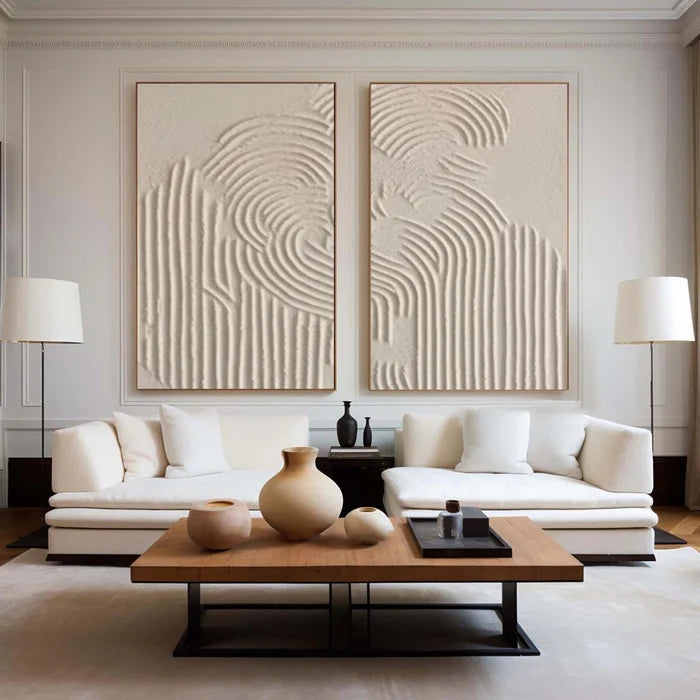
For a calm living room, consider softened desert landscapes, horizon-based abstractions, barns reduced to simple geometry, or paintings with tobacco brown, clay, sand, and muted blue. These pair naturally with linen upholstery, oak, leather, plaster finishes, and Wabi-Sabi-inspired ceramics.
For a more energetic room, look for bold graphic motifs, jukebox-era color, racing or sports references, city lights, comic-book-inspired forms, or expressive portraits. These can create a focal point in lofts, game rooms, offices, and eclectic dining areas.
A literal symbol can be effective, but composition matters. A flag-inspired painting with broken stripes, layered impasto, or aged color can feel more integrated in a contemporary home than a highly polished, centered emblem. Similarly, a vintage motel or gas-station scene may suit a modern interior when the painting uses a limited palette and clean spatial structure.
How Should You Choose the Right Size and Orientation?
Choose art according to the usable wall area and the furniture below it. As a practical starting point, artwork or a grouped arrangement often looks balanced when it spans roughly two-thirds of the furniture width; then adjust for the room’s ceiling height, visual density, and desired impact.
Measure the furniture, not only the blank wall. Above an 84-inch sofa, a total artwork width near 56 inches is a helpful starting point. That width may come from one large horizontal canvas, a diptych, or a closely related pair.
Horizontal paintings emphasize breadth and are well suited to sofas, beds, consoles, and low-ceiling rooms. Vertical paintings visually lengthen a wall, making them useful in entryways, stairwells, narrow wall sections, and beside tall furniture. Square paintings bring a compact, centered presence and often work well as a pair.
Before ordering from Vinchy Art, use painter’s tape or kraft paper to mark the intended dimensions on the wall. View the outline from the room’s main seating position and from the doorway. This simple test reveals whether the art will feel undersized, too dominant, or incorrectly oriented.
What Colors and Textures Create a Cohesive Look?
A cohesive scheme repeats or thoughtfully contrasts color, value, and material. Rather than matching every shade exactly, select a painting that shares two or three visual cues with the room: a warm undertone, a dark accent, a muted neutral, or a related material quality.
Start with the room’s dominant undertone. Beige walls may lean pink, yellow, gray, or green; white paint can appear warm or cool; wood may be honeyed, reddish, weathered, or espresso-dark. An Americana palette works especially well when its red, blue, cream, black, ochre, or tobacco tones are adjusted to those undertones.
Use contrast deliberately. A blue-gray room can gain warmth from rust and faded coral. A room with warm leather and oak can become more dimensional with indigo, charcoal, or blue-green. In a white minimalist space, a single stronger Americana accent can create focus without adding visual clutter.
Texture influences how a painting reads under changing light. Thick impasto, plaster-like relief, visible brushwork, dry-brush passages, and layered marks create shadows and tactile variation. Smooth paintings typically feel more graphic and controlled. Neither is inherently better: choose pronounced texture when the room needs material depth, and choose a flatter surface when furniture, rugs, or wall finishes already provide strong texture.
Why Does Lighting Matter for Hand-Painted Art?
Lighting changes the perceived color, contrast, and surface depth of a hand-painted work. Natural daylight can reveal brushwork and tonal shifts, while warm evening light may deepen earth colors and soften cool blues. Position, glare control, and bulb quality all affect the final result.
View the intended wall at several times of day. Strong direct sunlight can create glare, visually flatten a surface, and expose a painting to unnecessary heat and ultraviolet light. A wall with bright but indirect daylight is often easier to live with.
For artificial lighting, aim adjustable picture lights or ceiling fixtures toward the artwork without creating a harsh reflective hotspot. A wider beam suits larger work; a narrow beam can make small art appear isolated. If the room uses several light sources, check that the painting still looks balanced when only the usual evening lamps are on.
Textured contemporary Americana painting can be especially responsive to directional light because ridges and raised marks cast subtle shadows. That effect can add depth, but it should support the composition rather than become a distraction.
Can Contemporary Americana Art Work With Minimalist Decor?
Yes. Contemporary Americana art can complement minimalist decor when the work has a limited palette, clear composition, and enough negative space to coexist with clean-lined furnishings. Choose one significant piece rather than several competing nostalgic objects.
Minimalist interiors do not require colorless art. A restrained abstract work with a single dusty red gesture, indigo field, or weathered black line can provide character while preserving visual quiet. Consider paintings that reference Americana through palette, landscape rhythm, or material texture rather than dense literal imagery.
For a Wabi-Sabi-influenced room, seek irregular brushwork, earthy mineral tones, softened edges, and compositions that allow silence around the main forms. Pair the painting with unfinished wood, limewash walls, handmade pottery, linen, and low-profile furniture. The goal is not to recreate a historical American interior, but to let a contemporary work introduce warmth and cultural resonance.
In a more polished modern setting, a thin black, walnut, or natural-wood frame can give a canvas visual definition. For a casual, art-forward space, a frameless canvas may make the image feel more immediate. Confirm the exact framing choices on the selected Vinchy Art listing before finalizing a purchase.
How Should You Frame and Install the Painting?
Frame and install the painting according to its visual style, substrate, weight, and wall construction. A frame should clarify the work’s relationship to the room, while secure hardware should match the actual object and mounting surface rather than rely on a generic rule.
A natural oak or walnut frame often supports rustic-modern, organic, and warm-neutral Americana interiors. Black framing can sharpen graphic work, urban scenes, monochrome paintings, and bolder color compositions. A light frame can soften darker paintings against pale walls. If the art already has substantial painted edges or a strong sculptural surface, a frameless presentation may preserve its directness.
For placement, a common gallery-style starting point is to position the center of the artwork near 57–60 inches from the floor. Above a sofa, console, or bed, leave enough separation for the art to breathe while keeping it visually connected to the furniture. Adjust this starting point for unusually tall ceilings, seated viewing, or a larger multi-panel composition.
Use anchors and screws appropriate to drywall, studs, masonry, or other wall types. If a painting is large, heavy, or part of a multi-panel installation, follow the hardware guidance supplied for that exact item or consult a qualified installer. Do not assume hanging hardware, framed construction, or weight specifications are uniform across all Vinchy Art works.
What Should You Check Before Buying Online?
Before buying a hand-painted work online, confirm the exact listing’s orientation, finished dimensions, medium, canvas or framing option, color appearance, customization terms, and order-specific policies. Review the painting in the context of your actual wall, lighting, furniture scale, and delivery destination.
Photographs can shift across screens, so assess color families rather than expecting a perfect monitor-to-wall match. Ask whether the work’s dominant notes are warm or cool, muted or saturated, and high or low contrast. If you are matching upholstery, wood stain, or a particular paint color, share well-lit reference photos with the seller where room-preview or art-advisory support is available.
Hand-painted work can show natural variation from a reference image. Slight differences in brushwork, texture, edge detail, and color mixing are part of an individually produced painting. This is particularly relevant for made-to-order or customized art, where an exact machine-replicated duplicate should not be expected.
Vinchy Art states that many works are hand-painted and may be made to order. Its exact product pages are the appropriate place to verify current options, customization availability, artwork-specific materials, framing, and applicable order terms. For a large or custom piece, request a room preview if available and retain written confirmation of the selected configuration.
What Is Vinchy Art Expert Views?
“Treat Americana as a visual language rather than a decorating label. Begin with what the painting contributes to the room: horizon, movement, warmth, cultural reference, or contrast. A work succeeds when its scale relates to the furniture, its color responds to the room’s undertones, and its surface remains legible in the actual light. For made-to-order art, review the chosen dimensions, orientation, finish, and customization details before purchase. Handmade variation is not a flaw; it is part of the work’s physical character.”
This approach is particularly useful when comparing several artworks that share similar subject matter. The right painting is often the one that gives the room a clear focal point while leaving enough visual space for furnishings, architecture, and everyday use.
How Can You Care for a Hand-Painted Canvas?
Care for a hand-painted canvas by keeping it away from persistent direct sun, excessive humidity, heat sources, and rough cleaning methods. Dust gently with a soft, dry brush or clean microfiber cloth, avoiding water, household cleaners, solvents, and pressure on textured surfaces.
Do not hang canvas art directly above a working fireplace, radiator, stove, humidifier, or bathroom area with frequent steam unless the environment is reliably controlled. Repeated swings in temperature and humidity can stress canvas, paint layers, wood components, and framing over time.
When moving a painting, hold the frame or stretcher from both sides rather than pressing against the front surface. Avoid stacking unprotected canvases face-to-face. If the artwork is heavily textured, allow extra clearance so it does not rub against furniture, wall hooks, or packaging materials.
For cleaning beyond light surface dust, or if paint appears cracked, lifting, or damaged, consult a professional conservator. Do not attempt home repairs with glue, varnish, tape, or touch-up paint.
What Are the Most Common Questions About Contemporary Americana Painting?
Can Americana painting be abstract?
Yes. Abstract works can communicate Americana through regional color, landscape-like composition, vintage-inspired texture, cultural symbols, or references to roads, architecture, music, sports, and everyday life. Literal imagery is not required.
What room is best for Americana wall art?
Living rooms, entryways, dining rooms, offices, bedrooms, and media rooms can all suit Americana art. Match the work’s energy to the room: calm landscapes and muted abstractions suit restful areas, while bold graphic subjects often work well in social or active spaces.
Should I choose one large painting or a set of two?
Choose one large painting when the wall needs a singular focal point. Choose a diptych or paired set when you want rhythm, symmetry, or an arrangement that fills a wider span. Measure the total outside dimensions and spacing as one composition.
Can I request a custom size from Vinchy Art?
Customization may be available for certain Vinchy Art artworks, but availability depends on the exact listing and requested configuration. Confirm the selected artwork, size, colors, orientation, production details, and applicable order terms before placing a custom order.
How do I know whether a painting will look too small?
Tape the proposed finished dimensions on the wall and view them from normal distance. Art usually feels too small when it occupies only a narrow portion of a large furniture grouping or blank wall. Scale up when the room has wide furniture, high ceilings, or generous viewing distance.
What Is the Best Way to Choose Your Final Piece?
Choose a contemporary Americana painting that reflects your connection to American visual culture while fitting the physical realities of the room. Start with wall width and viewing distance, select an orientation that supports the architecture, then choose colors that either echo or deliberately offset the existing palette.
A wide, muted landscape or abstract composition can ground a sofa wall. A vertical city, roadside, portrait, or symbolic work can animate a narrow entry. Textured art benefits from considered lighting, while smoother graphic pieces can sharpen a modern interior. Decide whether a frame should blend the painting into the room or define it as a focal point.
When considering Vinchy Art, verify the exact artwork’s options rather than applying details from another listing. Confirm dimensions, orientation, finish, material information, customization, and order-specific terms. With those details aligned, the painting can feel intentional, personal, and visually lasting rather than merely decorative.