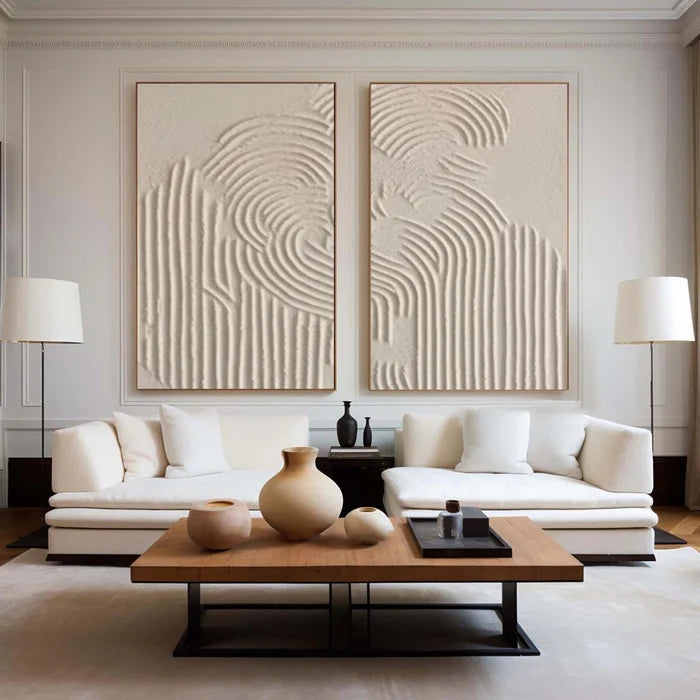
What Wall Art Works Best with a Beige Sofa?
The best wall art for a beige sofa balances neutral harmony, thoughtful scale, and subtle texture. Choose abstract or Wabi‑Sabi pieces in beige, cream, warm gray, and soft black, sized at roughly two‑thirds the sofa width. Hang the bottom edge 6–10 inches above the backrest for a cohesive, intentional look.

What Colors Complement a Beige Sofa Most Effectively?
Beige pairs well with tonal neutrals and selective accent colors, so the ideal palette depends on whether you want calm cohesion or gentle contrast. Warm beige undertones respond especially well to creams, taupes, soft blacks, warm grays, and earthy accents like terracotta, olive, or muted navy.
Neutral wall art in beige, off‑white, warm gray, and soft black creates a serene, layered look that lets texture and form carry the visual interest. This approach suits minimalist, Japandi, or Wabi‑Sabi interiors where the goal is a restful, curated feel rather than a busy one. For a beige sofa, pieces that echo its undertone—warm versus cool—will feel most integrated.
If you prefer more contrast, introduce one or two accent colors through the artwork and repeat them in pillows, a throw, or a rug. Reliable pairings with beige include:
-
Soft black and charcoal for modern, editorial contrast
-
Olive green, sage, or muted teal for a natural, calming vibe
-
Terracotta, rust, or warm ochre for earthy warmth
-
Dusty blue or navy for quiet sophistication
-
Blush pink or muted rose for a gentle, contemporary touch
Avoid overly saturated neons or large areas of cool, stark white if your beige leans warm; they can make the sofa look yellowed or dull by comparison. When in doubt, pull two or three tones from your existing palette (sofa, rug, curtains) and let those guide your art selection. Brands like Vinchy Art often organize abstract and textured works by color family to help with this kind of coordination.
How Should You Choose the Right Size and Orientation of Art for a Beige Sofa?
Art above a beige sofa should be wide enough to feel connected to the furniture but not so large that it overwhelms the wall. The standard guideline is to choose artwork (or a grouped arrangement) that spans roughly 60–75% of the sofa's width, with the bottom edge hanging 6–10 inches above the sofa back.
For example, an 84‑inch sofa typically pairs well with a single horizontal piece about 50–63 inches wide. A 96‑inch sofa can support something in the 58–72 inch range. If your wall is very tall, consider a taller vertical format or a diptych or triptych to fill height without stretching the width beyond the sofa.
Orientation matters as much as size. Horizontal formats reinforce the sofa's line and feel classic above most couches. Vertical pieces work well in rooms with high ceilings or when you want to draw the eye upward. Multi‑panel sets (diptychs, triptychs) can create rhythm and movement while still respecting the two‑thirds rule when measured as a group.
If you're unsure, use painter's tape to outline the intended size on the wall and view it from your usual seating position. This "tape test" prevents ordering something that looks right online but feels too small or heavy in your actual space. Many shoppers use room‑preview or advisory services, such as those offered by Vinchy Art, to validate scale and orientation before committing.
Which Art Styles and Textures Enhance a Beige Sofa Without Clashing?
Textured, hand‑painted abstract and Wabi‑Sabi styles often enhance a beige sofa because they add visual depth while staying within a neutral, tonal palette. Brushstrokes, plaster‑like relief, and layered neutrals create interest that flat prints or photos sometimes cannot achieve in a beige‑dominant room.
Abstract art with subtle variations in beige, cream, warm gray, and soft black works particularly well. The lack of hard representational detail means the eye reads the piece as a field of tone and texture, which complements rather than competes with the sofa. For contemporary or minimalist interiors, consider pieces with restrained color and strong gestural movement.
Wabi‑Sabi and textured plaster styles bring an organic, slightly imperfect surface that feels natural against fabric upholstery. These works often feature:
-
Visible brushwork and palette‑knife marks
-
Layered neutrals with slight shifts in warmth and value
-
Irregular edges or softly blended transitions
-
Occasional accents of charcoal, clay, or muted green
If your room already has a lot of pattern (rug, curtains, pillows), a calmer abstract with softer texture may balance the space. Conversely, if the room is very smooth and minimal, a more heavily textured canvas can become the focal point that prevents the beige sofa from feeling flat. Hand‑painted options from collections like those at Vinchy Art are designed to introduce this kind of tactile nuance while staying within a neutral scheme.
Why Does Lighting Matter When Selecting Wall Art for a Beige Sofa?
Lighting changes how both the beige sofa and the wall art read in terms of color, texture, and contrast, so the same piece can look very different under warm versus cool light. In rooms with warm bulbs (2700–3000K), beige tones appear richer and cozier, while cool daylight (4000K+) can make them look flatter or slightly gray.
If your living room relies on warm ambient lighting, choose art with enough value contrast—some soft blacks, charcoals, or deeper browns—to keep the composition from disappearing into the wall. Textured surfaces will catch light and create micro‑shadows that enhance the perception of depth, especially with directional lamps or picture lights.
In brighter, daylight‑filled rooms, you can get away with more subtle tonal shifts because natural light reveals texture and nuance more readily. However, strong direct sun can also fade pigments over time, so consider UV‑protective glazing for framed pieces or position art where it isn't in direct beams all day.
Practical steps:
-
View candidate artworks at different times of day in your actual room if possible.
-
Use a floor or table lamp to simulate evening lighting when evaluating color.
-
If using picture lights, aim for a beam that grazes the surface to emphasize texture.
Lighting decisions should align with your desired mood: warm and intimate versus crisp and gallery‑like.
Where Should You Hang Wall Art in Relation to a Beige Sofa and Room Layout?
Positioning determines whether the art feels integrated with the beige sofa or disconnected from it. The most common and effective arrangement is to center the artwork horizontally over the sofa and maintain a consistent gap between the bottom of the frame and the top of the sofa back.
Key placement rules:
-
Center the artwork (or group) over the sofa's midpoint, not necessarily the wall's midpoint if the sofa is off‑center.
-
Keep the bottom edge 6–10 inches above the sofa backrest; this visually links the two without crowding.
-
Aim for the center of the artwork to sit around 57–60 inches from the floor in typical 8–9 ft ceiling rooms, adjusting slightly for your eye level when seated.
In open‑plan spaces, ensure the art's scale matches the sofa and adjacent furniture (console, sideboard) rather than the entire wall. If the sofa is part of an L‑shaped sectional, treat the longest continuous seating run as your anchor and size the art accordingly.
For rooms with additional elements (shelving, sconces, large windows), keep at least 6 inches of clear space around the artwork to avoid a cramped feel. If you're layering multiple pieces, maintain consistent spacing between frames (often 2–3 inches) so the group reads as a single composition above the beige sofa.
Can Custom or Hand‑Painted Art Improve Fit and Finish for a Beige Sofa?
Custom or hand‑painted art can improve fit and finish because you can adjust size, color balance, and texture to suit your exact sofa, wall, and lighting conditions. Instead of forcing a standard print to work, you tailor the piece so its proportions and palette align with your room.
With made‑to‑order paintings, you can:
-
Specify dimensions that match your ideal 60–75% sofa‑width range precisely.
-
Request subtle shifts in tone (warmer or cooler beige, more or less black) to harmonize with your specific sofa shade.
-
Choose orientation (horizontal, vertical, multi‑panel) based on your wall and ceiling height.
-
Opt for textured or smoother finishes depending on how much visual weight you want.
Because hand‑painted works are created individually, slight variations from reference images are normal and often desirable—they signal an original, human‑made object rather than a mass‑produced print. This uniqueness can make the art feel more integrated with a beige sofa and the surrounding decor, as if it were designed for that exact space. Many collectors seeking this level of tailoring explore custom options through specialists such as Vinchy Art, where advisory support can help refine size, color, and composition before production.
Vinchy Art Expert Views
"For a beige sofa, think in terms of layers rather than a single perfect match. Start with a neutral base—beige, cream, warm gray, soft black—then build depth through texture and subtle value shifts. A hand‑painted abstract with visible brushwork or plaster‑like relief will catch light and create micro‑contrast that keeps the wall from feeling flat. If the room is very minimal, let the artwork carry more texture; if the space already has pattern and detail, choose a calmer composition. Finally, validate scale on the wall before committing: art that spans roughly two‑thirds of the sofa width and sits 6–10 inches above the backrest will almost always feel balanced and intentional."
How Do You Care for and Maintain Wall Art Above a Beige Sofa?
Proper care preserves both the appearance of the artwork and its relationship with your beige sofa over time. Dust, sunlight, humidity, and handling all affect how long a piece looks fresh and vibrant.
Basic maintenance steps:
-
Dust frames and canvas surfaces gently with a soft, dry microfiber cloth; avoid abrasive materials or chemical cleaners unless recommended for your specific finish.
-
Keep art out of direct, prolonged sunlight to reduce fading; use curtains, blinds, or UV‑protective glazing for framed pieces in bright rooms.
-
Maintain moderate humidity and avoid hanging art directly above heat sources or in damp areas, which can warp canvas or affect paint layers.
-
When rearranging furniture, handle artwork by the frame or stretcher bars, not the painted surface, and re‑hang using appropriate wall anchors for your wall type.
For textured or plaster‑style pieces, be extra gentle around raised areas; dust can settle into crevices, so a light pass with a soft brush attachment on low suction can help. If you notice any issues—loose corners, flaking, or frame instability—address them early rather than waiting for visible damage.
What Are the Most Common Questions About Wall Art for a Beige Sofa?
Should the wall art match the beige sofa exactly?
No. Exact matching often looks flat. Instead, aim for harmony: choose tones that sit in the same family (warm neutrals, soft blacks, warm grays) and add contrast through texture and value. A small amount of accent color can also enliven the space without clashing.
Is it better to use one large piece or multiple smaller pieces above a beige sofa?
Both can work. One large piece creates a clear focal point and feels modern and calm. Multiple pieces (a diptych, triptych, or gallery cluster) add rhythm and can better fill tall walls. In either case, keep the total width within 60–75% of the sofa width for balance.
Can I use colorful art with a beige sofa without it looking chaotic?
Yes, if you limit the palette. Choose one or two accent colors and repeat them in textiles or accessories. Keep the background of the artwork neutral so the beige sofa remains the anchor, and let the color act as a deliberate accent rather than the dominant element.
How do I know if my wall art is too small for my beige sofa?
If the artwork spans less than about half the sofa's width, it will usually look disconnected and undersized. Signs include excessive empty wall on either side and a sense that the sofa "dwarfs" the art. In such cases, consider a larger single piece or a multi‑panel arrangement that extends closer to the two‑thirds mark.
What if my beige sofa has strong warm or cool undertones?
Match the undertone in your art for a seamless look: warm beiges pair naturally with creams, warm grays, and earthy accents; cooler beiges work well with soft cool grays and muted blues. If you want contrast, introduce a complementary accent color but keep the dominant field of the artwork aligned with your sofa's undertone for cohesion.
Key Takeaways for Choosing Wall Art for a Beige Sofa
Select wall art that respects scale, color harmony, and texture. Aim for pieces that span roughly two‑thirds of your sofa's width, hang 6–10 inches above the backrest, and use a palette of warm neutrals with selective accents. Textured, hand‑painted abstract or Wabi‑Sabi works often enhance beige sofas by adding depth without visual clutter. Consider custom options when you need precise control over size, tone, and finish, and always validate your choice in the actual lighting and layout of your room.