Zen Home Decor: A Room-by-Room Guide to Calm Interiors
Zen home decor is not a style to buy — it is an order of operations applied room by room. Each room gets one task: the living room makes space to breathe, the bedroom subtracts, the entryway creates a ritual of arrival. Work in that order, one room at a time, and the home's calm builds without a single dramatic overhaul.
Five Principles, One Feeling
The zen home rests on five principles, and the room-by-room work applies them in different combinations. Space comes first: empty areas are part of the design, not gaps to fill. Restraint follows: fewer, better objects beat more, weaker ones. Natural materials — wood, linen, paper, stone — bring the calm that synthetic surfaces cannot. Light and shadow do the decorating that objects would otherwise crowd in. And order means a place for everything, so the eye never works to find its way.
The principles are the foundation, and the zen home decor article covers them in depth, with the what-is-zen-home-decor guide defining the style itself. The room-by-room work below applies the five principles where they matter most.
The principles also work as a test: before a room is called done, ask whether it has space, restraint, natural materials, light, and order. A room with all five reads as zen without needing the label; one missing two of them reads as decorated instead of calm. The test keeps the room-by-room work honest, and the five principles become the review checklist each room passes.
The order of the principles matters too: space and restraint come first, because a room cannot show materials or light through clutter. The rooms that fail the test usually fail on the first two principles, and the fix is subtraction before addition — clear the room, then let the natural materials and the light do their work.
Living Room: Space to Breathe
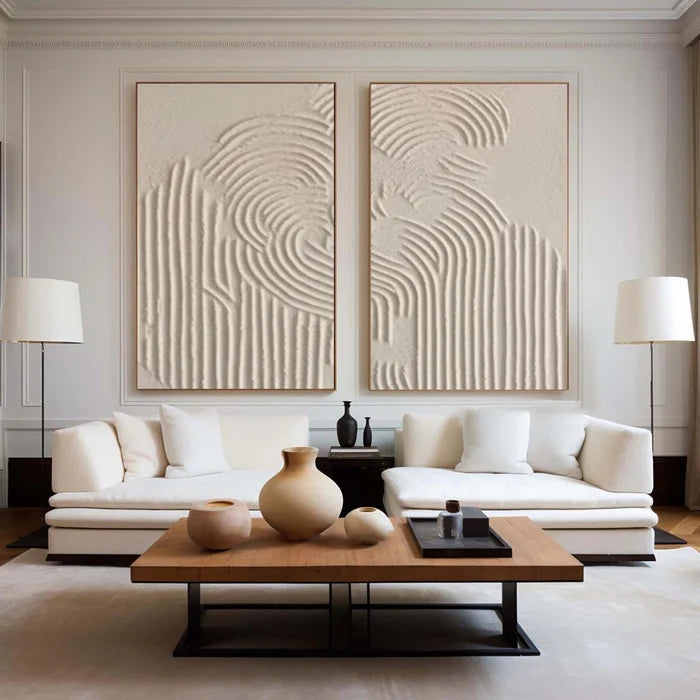
The living room's task is space to breathe: the room where people gather and rest should hold the fewest competing objects, and the art carries the composition a busy room would scatter. One calm piece on the main wall, sized to the sofa, leaves the rest of the wall quiet — the empty space around the art is the design.
The furniture joins the subtraction: one sofa, one rug, one table, one lamp family, and the art as the wall's single statement. The zen-wall-art collection holds the pieces that carry a living room wall on their own, and the rule is one focal point per wall, with the empty space protected.
The living room's breathing room also means the surfaces stay light: a console that holds one tray and one plant, a coffee table that clears between uses, and walls that carry one piece instead of a gallery. The room that breathes is the room that feels larger than it is, and the art's empty margins are what the eye reads as space.
The living room also sets the home's light standard: a window left clear of heavy drapes, a lamp family chosen for soft pools instead of bright washes, and a piece placed where the afternoon light reaches it. The room's calm is half furniture and half light, and the art shows both — the piece reads by the light the room lets in, and the empty wall around it holds the shadow.
Bedroom: Subtraction
The bedroom's task is subtraction: the room where the day ends should hold less than any other. The walls stay mostly quiet, the surfaces stay mostly clear, and one calm piece above the headboard carries the room's visual weight. The subtraction is the point — the eye has less to do, and the room reads as rest.
The bedding joins the palette: the duvet, the cushions, and the headboard share the wall art's tones, and the room becomes one calm composition instead of several competing ones. The 10 neutral bedroom ideas cover the palette end of the subtraction, and the rule is one piece, one tone family, and the rest quiet.
The subtraction also extends to the bedside: one lamp, one book, one small tray — the surfaces clear enough that the eye rests at the bedside instead of working. The bedroom's calm comes from what is absent as much as what is present, and the wall art is the one object the room asks the eye to hold.
Entryway: A Ritual of Arrival
The entryway's task is a ritual of arrival: the first five seconds inside set the home's mood, and a small, deliberate composition — one piece, one surface, one light — turns the door into a transition rather than a drop zone. The entryway art stands at standing eye level, and the console below it holds only what the arrival needs.
The ritual also includes the practical order: keys, shoes, and coats have their places, and the art marks the spot where the arrival settles. A home that greets itself with a calm wall arrives calm; one that greets with clutter arrives scattered.
The entryway ritual is also the home's first lesson in the five principles: a visitor reads the entryway's space, restraint, materials, light, and order in the first seconds, and the rest of the house confirms or corrects that first reading. The entryway done well makes the whole home's zen visible at the door.
Order of Operations
The order matters as much as the rooms: start with the room used most and finished first — usually the living room — then the bedroom, then the entryway, and let each completed room set the standard for the next. A half-done living room teaches the eye what "done" looks like, and the later rooms follow the same bar.
The order also staggers the budget and the effort: one room per season is a realistic zen pace, and the rooms connect through the same palette and the same restraint. The neutral bedroom art guide covers the calm bedroom side of the same process, and the rule is one room at a time, finished before the next begins.
The rooms also hand off their lessons: the living room teaches the space principle that the bedroom applies as subtraction, the bedroom teaches the restraint that the entryway needs for its ritual, and the entryway completes the loop by greeting every arrival with the standard the rest of the home keeps. The order is a chain, and each finished room strengthens the next.
Vinchy Art Studio Recommendation
In the Vinchy Art studio, zen decor is an order of operations: living room space first, bedroom subtraction second, entryway ritual third, with one calm piece carrying each room's wall. The studio recommends finishing one room before starting the next, keeping one focal point per wall, and letting the empty space do its share of the design. The zen collection holds the pieces that carry each room's task, and the preview confirms each piece before it ships.
Conclusion
Zen home decor is a room-by-room order, not a single purchase: the living room makes space to breathe, the bedroom subtracts, and the entryway creates a ritual of arrival — each with one calm piece and the empty space protected. Work in that order, one room at a time, and the five principles apply themselves. The home's calm is built from finished rooms, and each finished room sets the standard for the next.
Zen Room Checklist
- Living room: one calm piece, space around it
- Bedroom: subtraction, one tone family
- Entryway: one piece, one surface, one light
- One focal point per wall
- Empty space protected as design
- One room finished before the next
FAQ
How do I start making my home zen?
Start with the room used most — usually the living room — and give it space to breathe: one calm piece on the main wall, fewer objects, and the empty space protected. Finish the room before moving to the next.
What are the principles of zen home decor?
Space, restraint, natural materials, light and shadow, and order. The principles combine differently by room, and the room-by-room guide applies them one room at a time.
What art belongs in a zen home?
One calm piece per wall, sized to the furniture and muted in tone — a textured neutral, a soft landscape, a quiet abstract. The piece carries the wall, and the empty space around it is part of the design, not a gap to fill.
How is zen decor different from minimalism?
Zen adds the natural and the sensory — materials, light, texture — to minimalism's subtraction. The rooms share the restraint, and zen brings the warmth that bare minimalism can miss.
How long does a zen home take to complete?
The pace is one room per season or one room at a time, finished before the next begins. The order matters more than the speed, and each completed room sets the standard for the next — a calm home is a sequence of finished rooms, not a single overhaul.
Shop Zen-Inspired Art
Browse the zen-wall-art collection above at Vinchy Art for hand-painted, made-to-order pieces that carry each room's calm — with custom sizes and preview before shipping.