Entryway Art: Designing the First Impression of Your Home
The blue-green abstract collection holds the coastal tones for the same first-impression logic. Entryway art has about five seconds to do its job: welcome a guest, point the eye into the home, and set the tone for everything beyond the door. The wall where you drop keys and take off shoes is the room where first impressions are made, and a well-chosen piece turns that transition space into a deliberate composition. Plan the entryway wall as the home's opening statement, and the rest of the house reads differently from the first step inside.
Five Seconds to Set the Tone
The entryway is a transition room, and the art in it works differently from art in a living room. A living room piece is lived with for hours; an entryway piece is seen in passing, at the door, while the eye is still adjusting from outside light. That is why the tone matters more than the detail: a guest reads the entryway's mood before they read its art, and the piece should confirm the mood the moment they step in.
The entryway art has three jobs at once. It welcomes — a warm or inviting piece makes the arrival feel intentional rather than functional. It directs — a piece at the end of a hall or beside a door gives the eye a path deeper into the home. And it declares — the style of the entryway piece previews the style of the rooms beyond it, so a guest walks in knowing what kind of home this is.
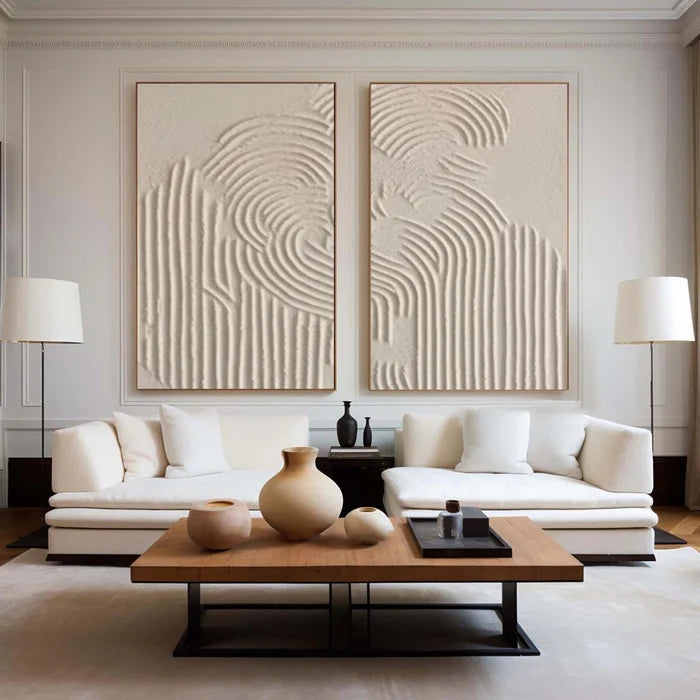
Choose the tone before the piece: a calm, muted painting for a home that stays quiet, a textured neutral for an organic-modern house, a deeper accent for one that enjoys contrast. The entryway sets the expectation, and the rest of the house confirms it.
The entryway's architecture shapes the task too. An open-plan entry that leads straight into the living room wants a piece that works at a distance, seen across the space. A closed foyer — a small room with a door — wants a piece that works up close, seen at arm's length while the door closes. A mudroom entry wants something durable in spirit: a calm piece that survives boots and bags without feeling out of place. Match the piece to the entry's shape, and the first impression lands in the first five seconds.
Size and Height for a Standing Glance
The entryway is read standing, so the size and height follow the standing eye. The piece's center should sit comfortably at standing eye level — neither so high that it floats above the sight line nor so low that it competes with hooks and shoes below. The standing test is simple: stand where you would enter, look at the wall, and the art should meet your gaze without you tilting your head.
The size follows the wall and the furniture beneath it. On a wall with a console or a bench, keep the piece at roughly two-thirds of the furniture's width, with the furniture as the anchor. On an empty entryway wall, keep the piece at half to two-thirds of the wall's width — large enough to register in the five-second glance, small enough to leave the wall breathing.
The narrow wall art guide covers the proportions for tight entry walls, and the size guide explains the two-thirds and half-to-two-thirds rules in detail.
Measure the entry wall around its obstacles before choosing the size: a wall with a door at one end is measured from the door casing to the corner, and a wall with a light switch or a thermostat is measured from that fixture to the edge. The entryway has more interruptions than most rooms — doors, switches, hooks — and the art's outer rectangle should stay clear of all of them. The piece that fits the wall's usable space reads intentional; the one that crowds the switch reads accidental.
Pairing With Mirrors and Benches
The entryway wall rarely stands alone: it shares the space with a mirror, a bench, hooks, and a shoe tray, and the art must join that composition rather than compete with it. The cleanest arrangement treats the wall as one unit — art, bench, and mirror planned together, with the art as the unit's visual top and the bench as its functional base.
The mirror works best across from the art or beside it, not directly under it: a mirror across the entry reflects the art and doubles its presence, while a mirror beside the art balances the wall without stacking two reflective surfaces. The bench below the art anchors the wall at furniture height and gives the eye a place to rest between the floor and the frame.
The rule is restraint: one art piece, one mirror, one bench, and one hook set per entryway wall. A wall with art, mirror, hooks, shelves, and a plant all competing reads as clutter in the five seconds a guest sees it. Choose the strongest element, let the others support it, and the entryway reads composed.
The bench also sets the art's practical clearance: the piece should clear the head of someone sitting on the bench, and the bench's back line should stay visible below the frame. In a family entry, that clearance matters more than the eye-line rule — a piece that grazes the tallest person's head every morning is a piece that eventually gets moved. Measure the seated line as well as the standing line, and the composition works for the whole household.
Small Foyers, Vertical Solutions
Small foyers need the same first impression with less wall to work with, and the vertical format is the compact solution. A tall piece beside the door fills the narrow wall without covering it, a vertical piece at the end of a short hallway gives the eye a stopping point, and a piece above a slim console follows the console's line instead of overhanging it.
In a very small foyer, one well-scaled vertical piece does more than a group: it registers in the passing glance, keeps the wall clear for hooks and a mirror, and gives the entry a single clear focal point. The vertical collection shows the range of tall formats built for narrow entry walls.
The scale discipline is the same as in any small space: the piece stays within the wall's width, the center stays at standing eye level, and the wall's other functions — hooks, mirror, bench — stay clear of the art's outer rectangle. One strong piece, properly placed, makes a small foyer feel designed rather than decorated.
The vertical piece also makes the foyer's light work harder: a tall format beside the door catches the light that enters with each arrival, and its edges frame the shadow play on a narrow wall. In a foyer with no natural light, a small picture light or an angled lamp can do the same job, keeping the vertical piece visible in the evening. The format and the light together give the small entry its five-second presence.
Vinchy Art Studio Recommendation
In the Vinchy Art studio, entryway art is planned as a five-second composition: the tone chosen for the arrival, the center at standing eye level, the size anchored to the wall and furniture, and the mirrors and bench arranged as one unit. The studio recommends one clear focal piece per entry wall, restraint around it, and a vertical format for narrow foyers. Vinchy Art's made-to-order sizing lets the piece follow the measured entry wall, and the preview step confirms the piece before it ships.
Conclusion
Entryway art works in five seconds: it welcomes, directs, and declares the home's style before the guest has taken off their coat. Plan the tone first, set the center at standing eye level, anchor the size to the wall and furniture, and let the mirror and bench support the piece as one composition. In a small foyer, one well-scaled vertical piece carries the whole wall. The entryway is the home's opening line — make it deliberate.
Entryway Art Checklist
- Tone chosen for the arrival
- Center at standing eye level
- Size anchored to the wall or console
- Art, mirror, and bench planned as one unit
- One focal piece per entry wall
- Vertical format for narrow foyers
FAQ
What size art should I choose for an entryway?
Roughly two-thirds of the console or bench width beneath it, or half to two-thirds of the wall width on an empty entry wall. The piece should register in a passing glance without covering the wall.
How high should entryway art hang?
The piece's center should sit at standing eye level, so a guest meets the art without tilting their head. Mark the center while standing where you would enter, and adjust before hanging.
Can I pair art with a mirror in an entryway?
Yes — the mirror works best across from the art or beside it, not directly under it. The mirror reflects the piece and doubles its presence, and the composition stays calm when one element leads.
What art works in a small foyer?
One well-scaled vertical piece: it fills a narrow wall without covering it, gives the eye a stopping point, and keeps the wall clear for hooks and a mirror. The vertical collection shows tall formats built for entry walls.
Should the entryway art match the rest of the house?
It should preview it. The entryway piece sets the style expectation for the rooms beyond, so a calm home wants a calm piece and a home with contrast can carry a deeper accent.
Shop Entryway Art
Browse the vertical collection above at Vinchy Art for hand-painted, made-to-order entryway pieces — with custom sizes and preview before shipping.