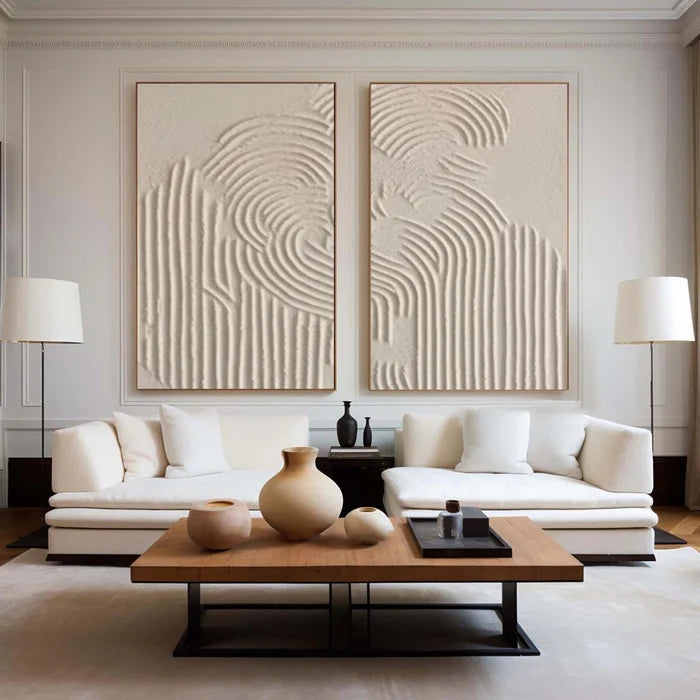
The Hallway Gallery Walk: Designing a Personal Museum
A hallway is walked, not sat in, which makes it the closest thing most homes have to a museum corridor: a space where art is experienced in sequence, at walking speed, with the eye moving from piece to piece. Plan the hallway as a gallery walk — a rhythm of spacing, height, and light that carries the eye from the front of the house to the back — and the corridor becomes one of the most composed rooms in the home.
The Corridor as a Narrative
The gallery walk works because a hallway has a direction: the eye enters at one end and leaves at the other, and the art can tell a story along that path. A calm piece near the entry gives way to a stronger piece mid-way, and a resolving piece at the end brings the walk to a close. The sequence turns a functional passage into a deliberate experience.
The narrative starts with the end wall. The wall at the far end of the hallway is the piece every visitor sees first and last, and it should carry the strongest or most resolved work. The side walls then support the walk with smaller pieces or a set, leading the eye toward the end wall's statement. Plan the end wall first, and the rest of the hallway arranges itself around it.
The pace of the walk matters too: a busy hallway near the kitchen wants a simple, fast rhythm, while a quiet hallway past bedrooms can hold a slower sequence with more pieces. Match the narrative to how the corridor is actually used, and the gallery walk feels natural rather than imposed.
The narrative does not have to be a single story — it can be a family's story. A hallway of family photos or children's art follows the same walk logic: the strongest image on the end wall, the supporting images in a measured rhythm along the sides. The pieces change over time, but the system stays, and the corridor keeps its gallery feel as the contents evolve.
Even Spacing vs. Rhythmic Pacing
The spacing along the hallway decides whether the walk feels calm or animated. Even spacing — consistent gaps between equal or similar pieces — creates a steady museum rhythm that suits a calm home and a narrow corridor. The pieces line up on one consistent eye line, the gaps stay even, and the eye moves smoothly from one to the next.
Rhythmic pacing — clustered pieces with deliberate pauses — creates a more animated walk that suits a wide hallway or a corridor with a story to tell. Two pieces close together, a gap, a larger piece, another gap: the rhythm gives the walk a beat, with the pauses as important as the pieces. Both systems work; the choice is the room's personality.
Whichever pacing you choose, the layout rules stay the same: the group follows one eye line (usually the standing eye), the pieces clear the doors and frames along the wall, and the spacing is measured rather than guessed. The wall display guide covers the general layout rules, and the set-of-3 collection provides the equal-size rhythm for the calm version.
The measurement starts with the corridor's length: measure the usable wall between doors and frames, then divide it by the number of pieces plus one, so the margins at each end match the gaps between pieces. A six-piece sequence on a long wall wants the same margin discipline as a two-piece set on a short one. The math turns the walk from a guess into a plan, and the plan is what makes a row of art feel like a gallery.
Lighting a Gallery Walk
Lighting turns a row of art into a gallery. A track light aimed along the wall gives every piece an even wash, wall sconces between pieces create pools of light with dark pauses, and a picture light above a key piece singles it out. The three approaches change how the walk reads — even wash for calm, pools for drama, and one spotlight for the end-wall statement.
The hallway's light also changes through the day: a corridor with a window at one end moves from bright to dim as the sun shifts, and the art should hold its presence in both. Textured pieces are a good fit for the evening version of the walk, because low, warm light catches the relief and keeps the pieces alive when the hallway is at its darkest.
Avoid the two common hallway lighting mistakes: a single overhead light that flattens every piece, and picture lights on every frame, which turns the walk into a strip of glare. Choose one lighting approach, aim it at the art's height, and let the walk have both lit pieces and restful shadow.
The hallway's natural light deserves a place in the plan too: a corridor with a window at one end gives the walk a bright opening and a dim close, and the sequence should be arranged so the strongest pieces sit where the light lands. For evening use, a timer or a motion sensor on the hall light keeps the walk lit without a switch hunt, and the art stays part of the nightly route rather than vanishing after dark.
Single Statement or a Sequence?
The hallway's length decides between a single statement and a sequence. A short hallway — a few steps from door to door — wants one strong piece, usually on the end wall, because there is not enough wall to build a walk. A longer corridor has the length for a sequence, and the narrative rhythm turns it into a gallery.
The single statement also suits a hallway that opens onto a room: one piece at the end of the passage gives the eye a destination without competing with the living room beyond. The sequence suits a hallway with solid side walls, where the length itself is the display space. Measure the corridor, count the usable wall, and let the length choose.
The narrow wall art guide covers the single-piece side of the decision for tight corridors, and the vertical collection shows tall pieces that carry an end wall on their own.
There is also a middle option for mid-length corridors: a small sequence of two or three pieces that reads as one group, paired with a statement on the end wall. The group carries the walk's rhythm, and the end piece resolves it — the corridor gets both the sequence's movement and the statement's focus without needing wall space for a full gallery.
Vinchy Art Studio Recommendation
In the Vinchy Art studio, a hallway gallery is planned as a walk: the end wall carries the strongest piece, the side walls follow one spacing system, and the lighting is chosen to suit the corridor's length and light. The studio recommends even spacing for calm corridors, rhythmic pacing for animated ones, and one lighting approach rather than a strip of glare. Vinchy Art's made-to-order sizes let each piece follow the measured wall, and the preview step confirms the sequence before it ships.
Conclusion
A hallway becomes a gallery when it is planned as a walk: the end wall carries the statement, the side walls follow one spacing system, and the light guides the eye from the front of the house to the back. Even spacing creates calm, rhythmic pacing creates a beat, and the corridor's length decides between a single statement and a sequence. Measure the wall, choose the rhythm, and the hallway reads as a personal museum rather than a passage.
Hallway Gallery Checklist
- End wall chosen for the strongest piece
- One spacing system: even or rhythmic
- Eye line consistent along the walk
- One lighting approach for the corridor
- Pieces clear of doors and frames
- Length deciding between statement and sequence
FAQ
How do I arrange a gallery wall in a hallway?
Plan the walk from the entry to the far end: one strong piece on the end wall, then a consistent spacing system along the side walls. Keep one eye line, measure the gaps, and let the end wall resolve the sequence.
What spacing works for a hallway gallery?
Either even gaps for a calm museum rhythm or clustered pacing with deliberate pauses for an animated walk. Whichever you choose, keep the spacing consistent within the system and clear of doors and frames.
How many pieces should a hallway gallery have?
As many as the length supports: a short hallway wants one statement piece, while a longer corridor can hold a full sequence. Count the usable wall and let the length decide.
What lighting is best for hallway art?
One approach chosen deliberately: an even track wash, wall sconces between pieces, or a picture light on the end-wall statement. Avoid a single flattening overhead light and picture lights on every frame.
Should the hallway have one big piece or several?
The length decides: short hallways and passages that open onto rooms want one strong statement, while long corridors with solid side walls reward a sequence. Measure the corridor and choose by the wall you actually have.
Shop Gallery Wall Pieces
Browse the set-of-3 collection above at Vinchy Art for hand-painted, made-to-order pieces that build a hallway rhythm — with custom sizes and preview before shipping.