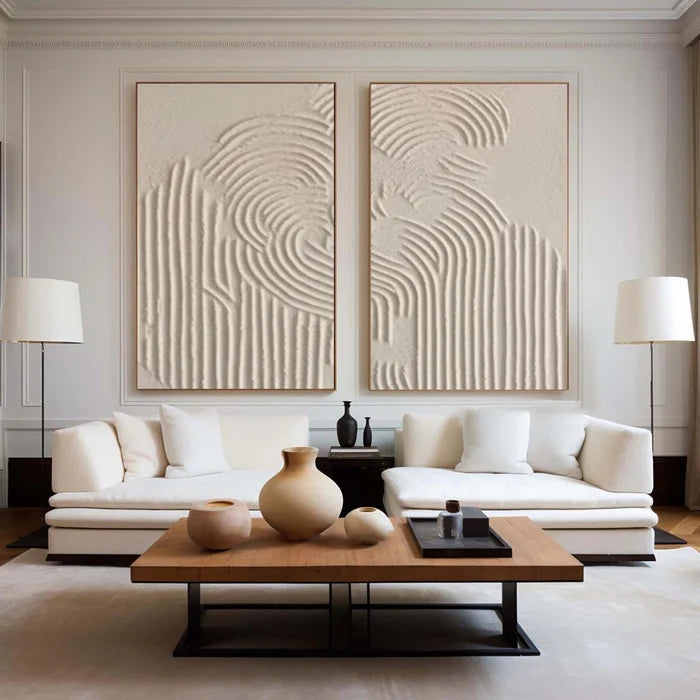
Texture Art Techniques: Impasto, Relief and Palette Knife Compared
Three words do the heavy lifting in textured art - impasto, relief and palette knife - and most guidance uses them as interchangeable buzzwords. They are not the same technique, and the difference ...
Read moreNatural Materials in Wabi-Sabi Interiors: Canvas, Plaster, Wood
Wabi-sabi is often described with words like quiet and imperfect, but the real engine is something simpler: material honesty. The aesthetic works because the things in the room - canvas, plaster, w...
Read moreWabi-Sabi Gifts: Choosing Imperfect Art That Means Something
Most art gifts fail in the same way: they announce themselves. A busy print says "I chose this because I know you like modern art," and the recipient's job becomes praising it. Wabi-sabi gifts work...
Read moreHow to Layer Wabi-Sabi: Texture, Light and Quiet Color
Wabi-sabi rooms photographed beautifully in magazines share a secret that has nothing to do with money: they are layered. The calm you see is not one perfect object - it is a sequence of surfaces t...
Read moreWabi-Sabi Textured Art in a Modern Loft: Juxtaposition Done Right
Lofts are the loudest rooms in interior design: concrete, steel, exposed ducts, tall windows, and a scale that makes most art feel small and most decoration feel lost. Wabi-sabi, by all logic, shou...
Read moreKintsugi and Wabi-Sabi: Imperfection as Design
Kintsugi is the Japanese craft of repairing broken pottery with gold, silver or platinum, leaving the seams visible and beautiful. Over the past decade it has become the clearest symbol of wabi-sab...
Read moreBuying Wabi-Sabi Art: Spotting the Real vs the Imitation
Wabi-sabi became fashionable, and fashion always brings imitations. The market now sells flat prints with a plaster-like texture printed onto paper, factory canvases with fake ridge shadows baked i...
Read moreWabi-Sabi for Small Homes: Making Imperfect Beauty Fit
Small homes have a special relationship with wabi-sabi: the philosophy loves bareness, and small rooms force bareness on you. What sounds like a match often goes wrong anyway, because the usual adv...
Read moreWabi-Sabi Colors: Neutrals With Material Depth
Wabi-sabi is often described through objects - worn wood, cracked bowls, faded linen - but for a room, the philosophy enters first through color. The palette is neutral on the surface and anything ...
Read morePlaster Art Materials: What to Check Before You Buy
If you are shopping for plaster art or getting into textured painting yourself, the materials list is shorter than the finished texture suggests. The visible ridges, waves and peaks come from a few...
Read more