Black Textured Wall Art: Adding Depth to Moody Interiors
Black textured wall art works because it is never truly flat black: the ridges catch light and cast shadows, so the surface reads as depth even in a dark room. The styling challenge is contrast — b...
Read moreWhite Textured Wall Art: Styling Bright, Airy Interiors
White textured wall art solves a problem every bright room has: a white wall can feel flat, and a white piece can disappear into it. The solution is contrast through texture, not through color — a ...
Read moreLarge Textured Wall Art for Open-Plan Homes: Scale Done Right
Large textured wall art is the open-plan home's natural anchor: one oversized piece can hold a wall that a row of small frames cannot. The scale rule is simple — keep the art at roughly half to two...
Read moreBedroom Texture: How Textured Wall Art Adds Tactile Calm
Textured wall art calms a bedroom through two channels at once: sight and touch. The muted surface reads as soft from across the room and invites a closer look up close, which lowers the visual vol...
Read moreTextured Wall Art for Modern Living Rooms: A Styling Guide
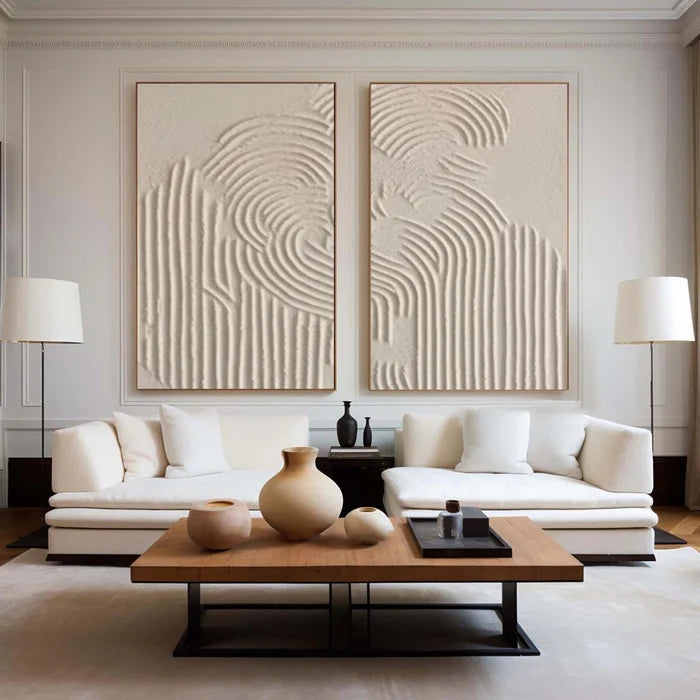
Modern living rooms need tactile warmth to balance their clean lines, and textured wall art provides exactly that: a hand-built surface that softens the geometry without breaking it. The styling ru...
Read moreTexture Painting Techniques: Palette Knife, Plaster, and Layering Explained
Texture painting techniques fall into three families: palette knife work, modeling with plaster, and layering with impasto. Each leaves a different fingerprint on the surface — knife work leaves cl...
Read moreTextured Wall Art vs. Flat Canvas: A Visual and Sensory Comparison
Textured wall art and flat canvas offer different experiences of the same wall: textured art engages the eye through depth and light, while flat canvas engages it through color and composition. The...
Read moreWhat Is Textured Wall Art? Types, Materials, and Why It Feels Different
Textured wall art is wall art whose surface is physically raised — built with plaster, textile, paper, wood, or composite materials — so it catches light and shadow instead of lying flat. It includ...
Read moreGifting Wabi-Sabi: Why Imperfect Art Makes a Thoughtful Present
Gifting wabi-sabi is giving a value, not just an object: the piece says imperfection is welcome and calm is worth keeping. It suits people who value handmade things, quiet rooms, and meaning over d...
Read moreA Wabi-Sabi Home Transformation: Room-by-Room Guide
A wabi-sabi home transformation works gradually: start with one wall, one piece, and one palette, then let the style spread room by room. The 90-day path below keeps the process manageable — every ...
Read more